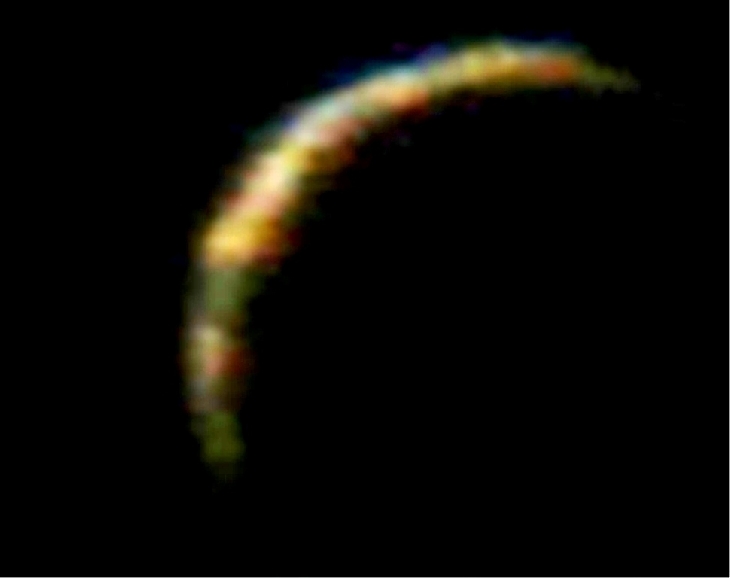
Colors of Scintillating Venus
Taken by Helio C. Vital on March 24, 2017 @
Rio de Janeiro, Brazil
Click photo for larger image

| |
Camera Used: Canon Canon EOS REBEL T1i
Exposure Time: 1/250
Aperture: f/inf
ISO: 100
Date Taken: 2017:03:24 15:25:16
|
|
| More images
Details:
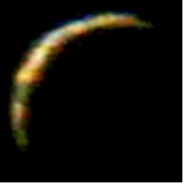
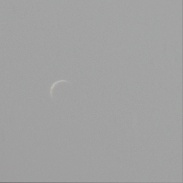
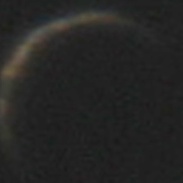
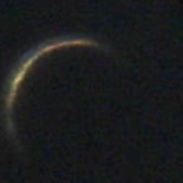
Earth's multilayered and mostly turbulent atmosphere acts like a dynamic set of moving lenses and prisms that play with the point-like light from the stars, causing their apparent brightness, color and even position to fluctuate or twinkle. Such effect, that includes the bending of light (refraction), is called scintillation. Its is usually negligible for planets because the multiple beams of light we receive from their disks tend to cancel out. However, the current situation of Venus is indeed quite interesting due to the fact that although the diameter of the planet has reached the impressive figure of 1 arcminute, its crescent is currently only 1% iluminated and thus it is extremely thin. As a consequence, it is very likely to be strongly affected by scintillation. As I was analyzing some photos of Venus I had just taken with a Canon Rebel T1i attached to a C8 (Cassegrain focus), I noticed that, as I further reduced the brightness of the images and intensified their contrasts, the crescent became segmented into a multitude of sections with colors that grew increasingly more vivid. I then realized that it could be a scintillation effect probably produced by anomalous refraction caused by small-scale fluctuations in air density that are usually related to temperature gradients. The photos were taken at 15:23-25 (GMT-3h) as Venus, at 38° altitude, was shining at m=-4.0 only 8.4° away from the Sun. The second photo was only cropped and resized. The third image shows the photo partially processed to bring out the colors produced by scintillation. The first image shows the same photo completely processed, displaying the same color distribution as the third image but with more vivid hues. Finally, the last image corresponds to the partial stage of processing of another photo, taken one minute later. Note that a completely different pattern of colors is exhibited.
Photographer's website:
No URL provided.
|
|
|