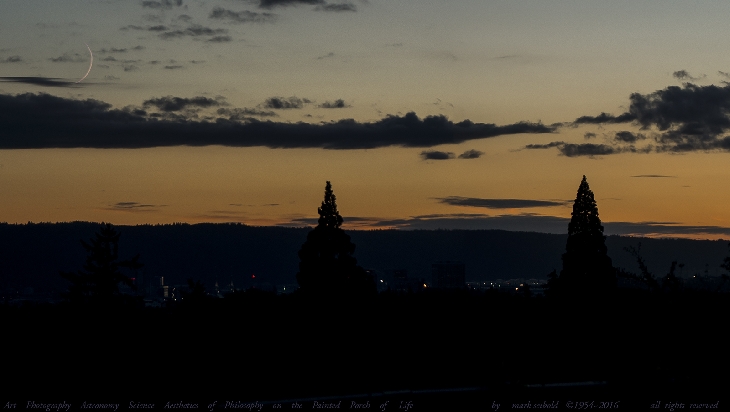
Venus Returning to Evening Sky with Crescent New Moon
Taken by Mark Seibold on July 5, 2016 @
Mount Tabor Park, Portland Oregon
Click photo for larger image

| |
Camera Used: Unavailable Unavailable
Exposure Time: Unavailable
Aperture: Unavailable
ISO: Unavailable
Date Taken: 2016:07:06 06:43:26
|
|
| More images
Details:
I arrived, I thought on time, or maybe even earlier, then realized the thin veil of broken clouds on the horizon, and where the sun had just set, and thought, oh no, Venus must be down near the horizon, then rushing to set everything up, the Cassegrain telescope, the camera all at once in a hurry, but low and beholden, it begins to draw a crowd, questions start flying, everybody demands answers, "what's happening?!... as I hear a young lady ask. Ok, I say to her, as I always try to inform and educate as my prime intent, yet it becomes more like like a stand-up comedy routine, as I know they all need Cosmic Relief, and from me it's all of the above and more; I'm more comic relief, but close friends will know I'm just humoring them at first. So I explain to her what I am trying to do, yet I'll allow her to observe so much more on the telescope, as several other large planets are there if you look behind you, but I have to photograph Venus and the crescent moon before they are set and gone, as it's a very narrow window. She's interested, and seeing all the high tech equipment, she wants to learn. I throw her my large binoculars, and instruct her, start looking now and carefully scan along the horizon starting where the brightest area is where the sun just set, and focus the binoculars with the center top wheel carefully on the distant horizon, slowly work your gaze to the left, you should see a bright star-like object near the bright orange twilight in between the little broken clouds. Then scan upwards to the left slowly and the thin crescent moon like a backwards letter 'C' should be about 10 degrees to the left of Venus somewhere possibly partly obscured in those broken clouds. "There it is!" she yells. Ok, I say, can you describe about where, as we strain to move around looking through the parks trees and clouds, I say, astronomers get used to working at this, where the general public just sees the sun go down, then they all walk away talking about rushing home to watch TV for the remainder of the evening. I know she says, this is why I left my original home in New York and moved out here to Seattle a few years ago, but now to Portland, as I found the people in Seattle becoming like New York, where Portlanders' seem so much more genuine and friendly. I never saw someone like this in Seattle or New York with a high tech telescope set up within minutes and teaching me more in 5 minutes than I got in a whole term in college. And oh, look! There's the moon! ...as she's spotted it in the binoculars, she focuses and describes the craters on the thin sliver of light, but notices that she cannot see the dark side yet. I say, you must be one of the few that even know that the Earthshine can be seen with the naked eye in the next few evenings. Just then, a husband and wife and child approach and ask what we are looking at. As zibdescribe it as a challenge and more a photo op for astronomers, the young lady shows them where to look, and I instruct again for them to use the binoculars. They've seen Venus now, then the moon, but because these objects are so low on the horizon tonight, they appear as distortedly diminished.....more to continue, with photos after pricessing soon, *on the way home now... I'm snapping away with the camera over the telescope eyepiece, while she continues to observe through the binoculars, I realize that Venus is not as bright as I had expected, as it is currently on the other side of the sun. So I concentrate on photographing the thin sliver of the Crescent moon through the telescope... surprised to get anything tonight, now discovering that the atmosphere is showing better than average seeing conditions.
Sony NEX aimed through a Celestron Nexstar 5i with 32mm Super Plossl eyepiece. 1/2 second shutter exposure, ISO 200 18mm~55mm lens at 18mm.
Photographer's website:
http://www.dpreview.com/galleries/1579463287
|
|
|