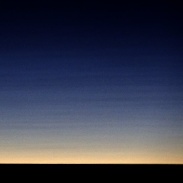
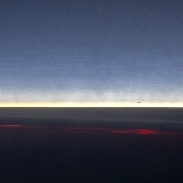
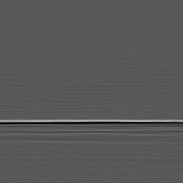
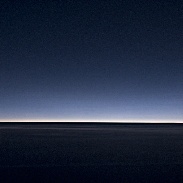
some kind of very high altitude clouds ?
Taken by Sylvain Chapeland on January 26, 2015 @ Germany
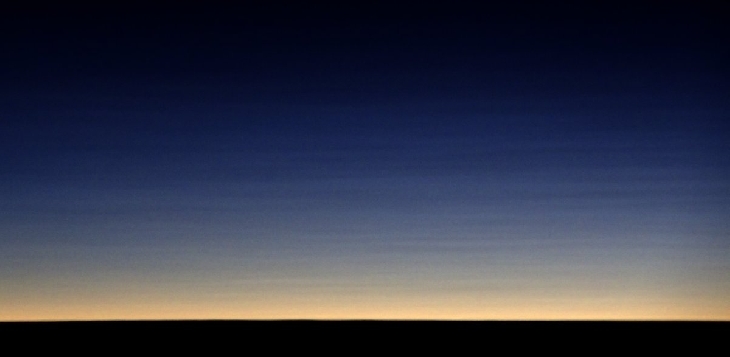
Click photo for larger image
  Camera Used: Unavailable Unavailable
Exposure Time: Unavailable
Aperture: Unavailable
ISO: Unavailable
Date Taken: Unavailable
 
More images
Details:
I took an early flight this morning, and shortly before sunrise, while looking at Venus from the window, I noticed some very high altitude ripple-like clouds 2° over the east horizon. They were quite faint, low contrast, making mostly horizontal parallel luminous bands with a gentle blue/white color. We were flying at 40000ft over Germany, around 7:45, 10 minutes before sunrise. https://fr.flightaware.com/live/flight/KLM1924/history/20160126/0610Z/LSGG/EHAM They are also visible on pictures taken with a Canon G16 - raw mode, especially after high contrast and unsharp processing. I was wondering if these clouds are somehow acquainted with the noctilucent clouds, as it is neither the season nor the typical latitude. However, they looked to be very high compared to the cirrus layer just below us, my guess would be in the 40-80km range. Or could it be just some optical or shadow effect projected on a high altitude layer?
Photographer's website:
No URL provided.
Comments
  You must be logged in to comment.  
Well spotted! I have been watching, observing, and photographing this for many years and the first thing I must say is yes! They are there. Usually, there is nothing, but often there is an extremely thin unnoticeable presence. At times, it is completely obvious, but only if you are looking! They are not Noctilucent clouds, and are much lower in the stratosphere between 50,000 and 60,000 feet, in the domain of Nacreous clouds, but unrelated. The best Ive been able to come up with, although there could be several causes, is that it is often linked to volcanic aerosols. My biggest problem is that I cant find an information source to compare with my observations, unless there is a big one. Sulphuric aerosols seem to get trapped at about 55,000 feet for weeks and circumnavigate the globe becoming white-ish, like thin cloud, but almost completely undetectable. But at sunrise and sunset, they can sometimes become more obvious when the sun shines upon them and the observer is still beneath direct sunlight. By the time the sun rises to shine on the airborne observer, the subtle features are usually lost. In extreme cases you can get a silhouette observation. If you find out any information, or another reader wishes to contribute, please post here or contact me. Thanks. AstroPilot.info
Posted by AstroPilot 2016-01-29 04:45:00
Thanks for your feedback! Im glad you could provide some info,
it indeed looks like something not widely documented! Your observations report seems to match very well the elusive appearance of this tenuous clouds. Your picture of a big event (http://astropilot.info/images/atmosphere/SulphurDioxide-Canada-2009-AstroPilot.jpg) is very much similar in structure (but of course with much higher contrast).

I agree that a kind of satellite map would be very useful to check such observations! cheers, Sylvain.
Posted by schap 2016-01-30 09:30:34
 
The Northern Lights: A Magic Experience
Aurora photo tours
Support SpaceWeather.com
Home | FAQ | Contact the Webmaster
©2019 Spaceweather.com. All rights reserved.