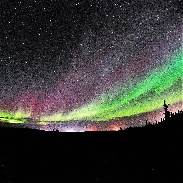
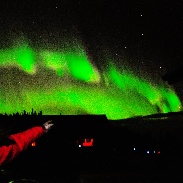
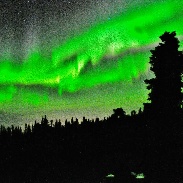
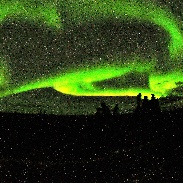
Interesting grain pattern in your images, Randall. Unless the aurora is moving too fast, you can use a longer exposure with a lower ISO to prevent some of the grain. Divide 8mm into 400 (some use 500 for their calculations), and you could open the shutter for up to 50 seconds before the stars start to trail. I often use 15 or 20 second exposures. Keep at it!
Thanks JohnAshley. As you can see from the remaining 3 pictures, there is far less grain, although still present. And you are again correct, the aurora was FLYING during the G2 and G3 storms of the night of 9/11-12(note the soft edges of the aurora vs. the sharp trees on the 2 sec exposures). The grain was mainly introduced by the limited post processing I did in trying to show the RED which was visible to the naked eye but minimized by my cameras sensitivity bias to green. The noise mainly came from my (over) boosting of shadows/low light areas. I tried many different white balance settings on my camera--auto, cloudy day, manual color temp, etc. but never got a true color image from my camera. Any suggestions on white balance settings? Thx again.
Randall, white balance at night is difficult at best, and Im pretty bad at it myself. I always shoot in camera RAW and manually adjust the WB until it looks natural enough. If low density areas need boosting, use curves instead of shadow/midtone/highlight sliders. Then try noise reduction in the sky. Itll blur the area slightly but it also removes grain and looks more natural to my old eyes. The camera is trying to record whats really there, which is different than what our eyes interpret, and neither version is entirely accurate.