C/2014 Q2 Lovejoy
Taken by Deirdre Kelleghan on January 18, 2015 @
Coynes Cross Co Wicklow
And Bray Co Wicklow
Click photo for larger image

| |
Camera Used: Unavailable Unavailable
Exposure Time: Unavailable
Aperture: Unavailable
ISO: Unavailable
Date Taken: Unavailable
|
|
| More images
Details:
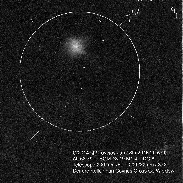
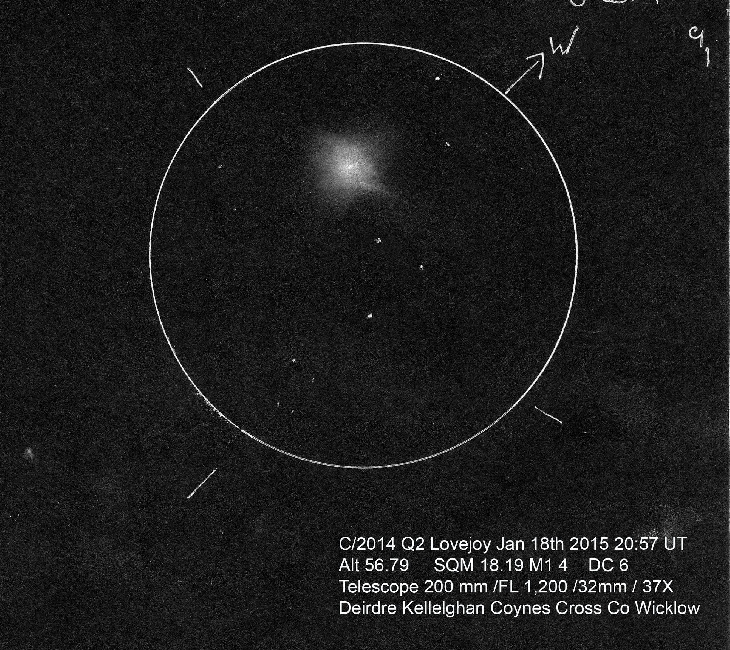
C/2014 Q2 Lovejoy Jan 18th and 19th 2015 Co Wickow Ireland 2 sketches
Telescope - 200 mm FL 1,200 mm / 32mm / 37X Alt 56.79 SQM 18.19 M1 4 DC 6 - Coynes Cross 20:57 UT
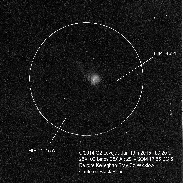
Binoculars 25X100 25X Jan 19th 2015 Alt 29 degrees SQM 17.55 M1 4 DC 6 - Bray 00:20 UT DC 6 M1 4 Conte on black paper -1 C
Heading down the N11 Orion directly in front of me - nice.
Coynes Cross is a bit darker than Bray my intention was to sketch Lovejoy and hopefully see and include its fine tail. Set up my 25x100's only to find that the comet was so high ( 56.79 degrees) that I was unable to angle the binoculars to catch it at that time. The double cluster was naked eye , M31 with averted gaze. Comet not naked eye.
Luckily I had thrown the dob in the car.
As the coma presented differently to my eye I decided to use white Conte as opposed to the pale grey I had used previously with the binoculars.
A massive circular coma with a bright stellar centre. The edges seemed wispy almost like a fringe.
I was more aware of the particles within Lovejoy in the telescope view , even though they were dense and obviously abundant. The entire coma appeared radiant and although it's shape was simple and beautiful its complex dynamics proved very difficult to capture.
Material seemed to be jetting out in several directions . However in my view no fine ion tail even hinted itself to my eye. The coma's white mass had a very distinct bright point centre surrounded by dense less bright material.
Toward all edges the edge seemed to continue but what the shape or structure was not clear no matter how much I looked and looked .
Later at home Lovejoy had dropped in height to 29 degrees and was comfortable in binoculars.
I was seriously surprised when I could see some tail, and I even noticed tentacle like gas streams for a short time .
My only conclusion is that even though the comet was lower the seeing must have improved because the transparency had not .
Similar moments happen when observing Jupiter's banding . A few seconds of improvement in the atmosphere can reveal detail hidden to the eye sharply but briefly. I didn't tidy up these images as that would lose some of the fine detail I mention in the observation, hence the finger prints, dust from the Conte and the grain of the paper.
Photographer's website:
http://www.deirdrekelleghan.net/
|
|
|