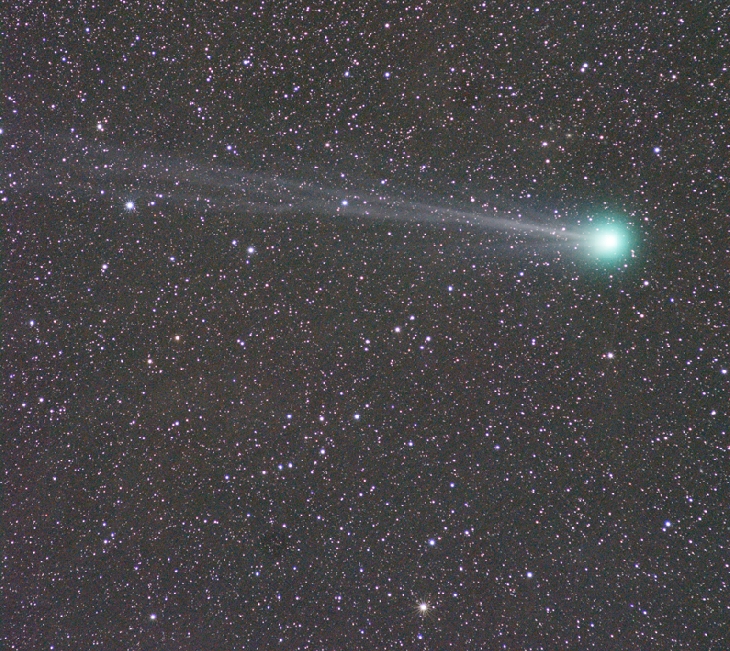
Comet Lovejoy (c/2014 Q2)
Taken by Jan Curtis on January 24, 2015 @ Nikon d7100, Nikkor 180mm AIS ED F/2.8 lens @ f/5. Taken at 6:45PM MST. iso 2500, 9x120s. High clouds moved in only after taking 9 subs. I was very lucky to capture Lovejoy tonight. Moonlight becoming increasingly bright. I was barely able to see the comet naked eye while overhead. Image was not post-processed except for PixInsight star alignment and integration.
Click photo for larger image
  Camera Used: Unavailable Unavailable
Exposure Time: Unavailable
Aperture: Unavailable
ISO: Unavailable
Date Taken: Unavailable
 
More images
Details:
Nikon d7100, Nikkor 180mm AIS ED F/2.8 lens @ f/5. Taken at 6:45PM MST. iso 2500, 9x120s. High clouds moved in only after taking 9 subs. I was very lucky to capture Lovejoy tonight. Moonlight becoming increasingly bright. I was barely able to see the comet naked eye while overhead. Image was not post-processed except for PixInsight star alignment and integration.
Photographer's website:
No URL provided.
Comments
  You must be logged in to comment.  
Hello Jan Curtis,
I really like your Comet Lovejoy image.
1.)Can you help me understand why did you image at F/5 and not F/2.8?
2.)What was the seeing like when you imaged this comet?
3.)How did you precess this image to get the comet tail as nice as you did? I have a modified Canon 6D and have not had good seeing to image this comet for good images as I would like.
4.) Do you see the comet tail in all your RAW images before doing any processing? Or is the tail only seen after you stack and process the images?

Kind Regard
Philip Smith
Posted by Philip Smith 2015-01-25 02:00:24
Hi Phillip:

Thanks for the feedback and kind words. I will try to answer your questions in the order asked:

1. While f/2.8 yields more light gathering, stars are blotted and colors muted so f/5 yields tighter stars.

2. The comet shows up nicely when I look at the camera screen after my exposure. I see the entire tail although not as defined as an integration of all the subs.

3. The Nikon d7100 has an optimal iso of 1250. That is the best signal to noise ratio. However, it does extremely well at higher iso (e.g. 3200 to 6400). Although not modified, the reds in nebula come out pretty well. Since I shoot with the Milky Way visible, my higher altitude, dry air, and dark skies make my shots more effective for capturing DSOs and comets. Of course CCDs do a much better job than the dSLR.

4. Yes as described above. Stopping down to f/5 is best for my particular Nikkor 180mm lens. Spherical aberration is noted over my top left part of my lens. Thankfully, much of my lens is distortion free or limited. The sweet spot is just to the lower right of the center of the lens.

If you would like a copy of a RAW file (in jpg format so that the size is manageable), send me your email address. Mine is: jancurtis.nl@gmail.com

Regards,

Jan
Posted by jcurtiswy9 2015-01-25 11:49:51
I like compliments
Posted by cinzi54 2015-01-25 12:12:53
 
The Northern Lights: A Magic Experience
Aurora photo tours
Support SpaceWeather.com
Home | FAQ | Contact the Webmaster
©2019 Spaceweather.com. All rights reserved.