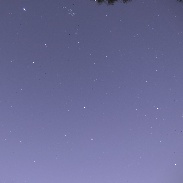
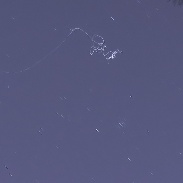
probable meteor or space junk
Taken by William McAulay on November 26, 2014 @ Fullerton, CA. USA
Click photo for larger image
  Camera Used: Canon Canon PowerShot G16
Exposure Time: 300/10
Aperture: f/2.2
ISO: 160
Date Taken: 2014:11:26 06:36:43
 
More images
Details:
Canon powershot G16 30 second exposure 11/26/14 5:37AM Fullerton, CA. centered AZ 180 degrees ALT approx. 70 degrees
Photographer's website:
No URL provided.
Comments
  You must be logged in to comment.  
this is similar to the image I captured when a neighbor had LEDs on a kite and the string. Although this looks more like it could be a UAV, drone, RC aircraft with LEDs. Could even be an LED equipped RC glider! Much too wavy for a reentry event....
Posted by dougr855 2014-11-29 16:52:05
Im with dougr855 on this one ... probably a UAV or drone. The vertical movement looks too erratic for a meteor entry. Interesting capture!
Posted by marion165 2014-11-30 10:49:28
If the camera moved, why didnt it affect the other star trail images? I would think all stars in the field would show the same trails if the camera moved.
Posted by DinkyPinky1 2014-11-30 09:25:40
As I said (my first post dissaperared!) this is an effect of camera or tripod movement. You can crearly see the light path joining the phenomenon to the brighter star. Only the brighter one could briefly excite the chip during the short period of erratic movement.
Posted by eirexas 2014-12-01 02:04:28
I realize you may or may not take my word on this, but the camera never moved, the tripod never moved and even though I live in earthquake country there was no earthquake. The Orange County Astronomy Assoc. thinks this is an object entering atmosphere and burning up, they cant explain the swirly trail but think one possibility is an irregularly shaped object kind of winging like a boomerang might do.
Posted by DinkyPinky1 2014-12-01 08:21:50
Dr. Krupp of the Griffith observatory sent me the following. It seems EIREXAS had it right all along. Ill have to keep my day job.

Thank you for your message sent 28 November 2014. I asked Tony Cook to take a look at the image you sent, and he quickly judged the
twisted luminous filament is the trail left by Jupiter after the shutter was opened and the camera was bumped and moved. The tortured trajectory ends at Jupiter, and you only see a thread of light attached to Jupiter because it is the only object bright enough to have left a conspicuous trail. If you enlarge the image dramatically and examine the image of Procyon. which is the second brightest object in the field (near the center, just a little off to the right), you will see that it, too, has a thread of twisted light attached to it, but it is much fainter and shorter than the thread attached to Jupiter. Because Procyon is much fainter, the only part of the trail bright enough to have been recorded corresponds to the small knot of light right next to Jupiter and at the end of the thin, faint thread that reaches to Jupiter. All of the stars actually moved just as Jupiter did, but they were all too faint to leave evidence. Only Procyon left some incomplete evidence but enough to confirm what we are seeing.

Sewing up the mystery,

Dr. Ed Krupp, Griffith observatory
Posted by DinkyPinky1 2014-12-02 06:43:42
I really dont agree with the camera/tripod moving explanation. There are at least 25 other stars in the full image that are bright enough to have shown movement. I take tons of pictures. Ive had the tripod move on me many, many times. You can most certainly tell when the camera moves. That picture does not show camera movement. That has to be some type of remote controlled craft with lights or quiet possibly a kite with lights.
Posted by AdamS84 2014-12-11 21:49:20
 
The Northern Lights: A Magic Experience
Aurora photo tours
Support SpaceWeather.com
Home | FAQ | Contact the Webmaster
©2019 Spaceweather.com. All rights reserved.