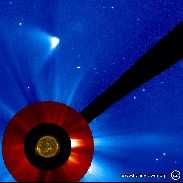
Comet ISON transitioning post perihelion
Taken by Charles Coburn on November 28, 2013 @
Rescue, California USA (online SOHO)

Click photo for larger image

| |
Camera Used: Unavailable Unavailable
Exposure Time: Unavailable
Aperture: Unavailable
ISO: Unavailable
Date Taken: 2013:11:29 00:12:01
|
|
| More images
Details:
I think comet ISON has survived it's plunge into the sun's atmosphere! NASA and other's proclaimed that the comet had disintegrated in the sun's atmosphere, but then something emerged from the other side. They said it was likely a "Ghost" or "Headless Comet" caused by the debris field following the trajectory.
But I've been watching it all day and to me it looks like the tail is swinging around a nucleus that is generating more material. This is what one would expect from an intact comet, as the comet rounds the sun, it's tail gets blown ahead of it on on the way out by solar winds which are much faster than the comet. I think this sequence of four captures I made today shows that transition.
This is exciting to me because since childhood I've been fascinated by this phenomenon and wondered just how the tail transitions from one side to the other. This doesn't look like the textbook illustration of the swing happening at perihelion (closest point, but rather a bit delayed because the of what I would assume is the comet's tangental speed so near the sun. But then nobody has ever seen a sun-grazing comet act like this one. Maybe this delay is due to it's extreme proximity to the surface (less than a million miles at one point).
We'll have to see what the "real" astronomers say once they wake up and look at the data. I'm guessing it will survive, but will remain a challenge to see due to it's diminished size. I won't be able to try to take pictures of it until next weekend if weather permits since it will be too close to the sun until then.
Photographer's website:
No URL provided.
|
|
|