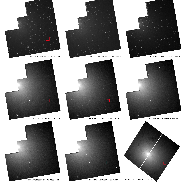
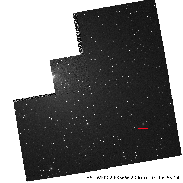
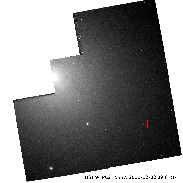
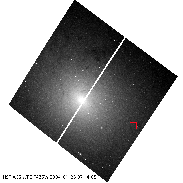
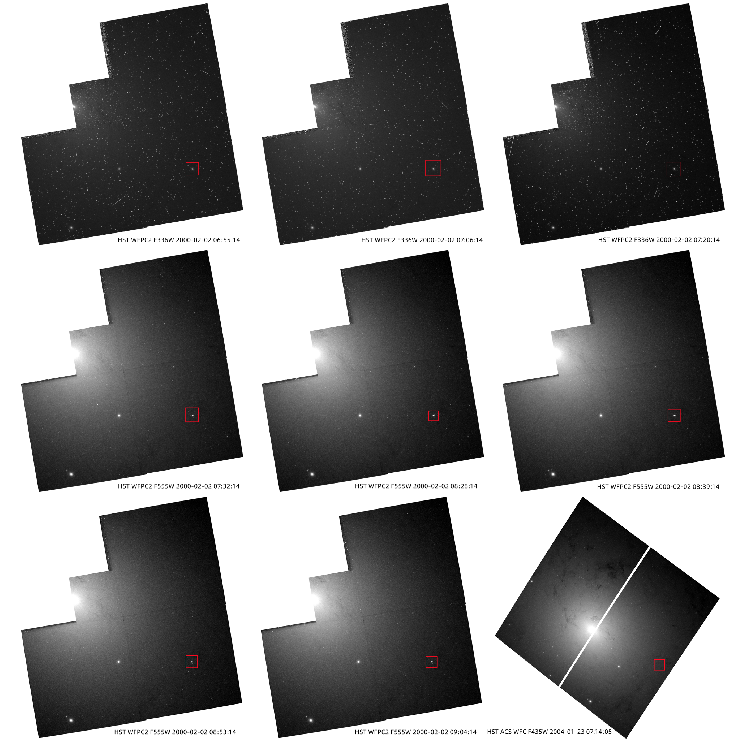
A possible nova in M31 was discovered in archival data from the Hubble Space Telescope (HST)
Taken by Jingyuan Zhao on February 2, 2000 @
China
Click photo for larger image

| |
Camera Used: Unavailable Unavailable
Exposure Time: Unavailable
Aperture: Unavailable
ISO: Unavailable
Date Taken: Unavailable
|
|
| More images
Details:
I serendipitously discovered a previously unknown nova candidate in M31 from archival Hubble Space Telescope (HST) images; it has now been designated AT 2000gq = M31N 2000-02a (https://www.wis-tns.org/object/2000gq )!
It is clearly visible in three HST-WFPC2 F336W-filter and five HST-WFPC2 F555W-filter frames obtained on 2000 February 2 as part of HST Proposal 8553 ((PI: Dr. Michael R. Garcia, DOI: 10.5270/esa-6188rld, https://hst.esac.esa.int/ehst/#/pages/search;proposal=8553, https://archive.stsci.edu/proposal_search.php?mission=hst&id=8553 ), it isn't detected in images taken on other dates.
The newly identified optical transient (R. A. = 00 42 36.790, Decl. = +41 15 23.68) doesn't coincide with the X-ray transient reported in the HST Proposal 8553 (R.A. = 00 42 42.18, Decl. = +41 16 08.4, equinox 2000.0; 90-percent error radius 2″.0; see IAUC 7291: http://www.cbat.eps.harvard.edu/iauc/07200/07291.html ), the two positions differ by approximately 1.3 arcmin. Therefore, they are unrelated.
According to MPChecker, there are no known asteroids at this position. I also checked A Living Catalog of Novae in M31 (https://ashafter.sdsu.edu/m31_nova_table.html ), CBAT TOCP, TNS, SIMBAD, VSX, and VizieR; there is no known nova (candidate) at this position. The nearest one is M31N 2010-02a, about 6 arcsec away. The new optical source therefore appears to be a previously overlooked transient.
This may be the first time a nova (candidate) in M31 has been discovered in Hubble Space Telescope data.
Photographer's website:
https://www.wis-tns.org/object/2000gq
|
|
|