More images
Details:
 |
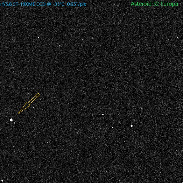
It is the sixth-largest asteroid in the asteroid belt, having a diameter of over 300 km.
It is shaped like an ellipsoid with approximate dimensions of 380×330×250 km.
It was discovered on 4 February 1858, by Hermann Goldschmidt from his balcony in Paris.
It is named after Europa from Greek mythology, a name it shares with Jupiter's moon Europa
and Europa (in Scandinavian language) on earth.
https://en.wikipedia.org/wiki/52_Europa
Hermann Mayer Salomon Goldschmidt (1802 – 1866) was a German-French astronomer
who spent much of his life in France. He started out as a painter, but after attending a lecture by the
famous French astronomer Urbain Le Verrier, he turned to astronomy. His discovery of the asteroid Lutetia in 1852 was
followed by further findings and by 1861, Goldschmidt had discovered 14 asteroids and thereby passed the record of John Russell Hind,
who had discovered 10 asteroids.. He received the Gold Medal of the
Royal Astronomical Society in 1861 for having discovered more asteroids than any other person up to that time.
The 115 km diameter lunar crater Goldschmidt is named in his honor.
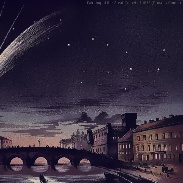
Here is also his painting of the Great Comet of 1858 (Donati’s Comet)
https://en.wikipedia.org/wiki/Hermann_Goldschmidt
Some nearby stars reveal themselves by their proper motion over a period of time from
approximately 1955 to the present day.
Distance from the Sun (au) : 2,89
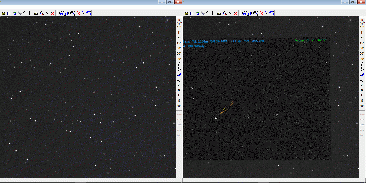
Time: 21:48UT 2025-11-16 Exp.2 x 5 sec.
Tel. 0.254m f/5.8 ST-10XME CCD @ -35°C 0.95"/pix
Odd Trondal Obs.code 238 (Uranium). Oslo Norway.
Software used:TheSky6,CCDSoft 5, MSB Astroart 2.0, 8.0, Paint
|
Photographer's website:
https://www.flickr.com/photos/odd_trondal/
|