Moon Thru Earth's Umbra
Taken by Alan Dyer on August 27, 2026 @
Waterton Lakes National Park, Alberta
Click photo for larger image

| |
Camera Used: Canon Canon EOS R5
Exposure Time: 8/1
Aperture: f/1.8
ISO: 100
Date Taken: 2026:08:31 17:34:12
|
|
| More images
Details:
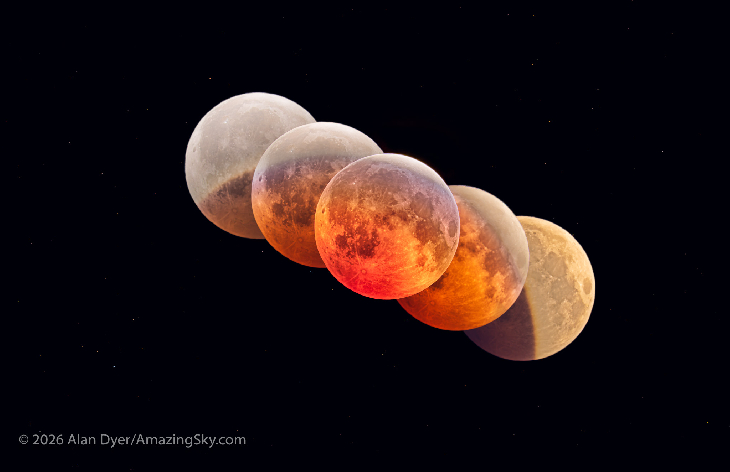
This is a composite of photos illustrating the actual passage of the Full Moon through the northern portion of Earth's umbral shadow on August 27, 2026.
This was not a total eclipse. At mid-eclipse at centre (at about 10:15 pm MDT) about 96% of the Moon's disk was in the umbra. The 4% still lit directly by the Sun remained bright white, looking like a "polar cap" at the top of the Moon's reddened disk. The southern, or bottom, portion of the disk was deepest into the umbra and so was darkest and reddest.
The four flanking images show the progress of the Moon through the shadow due to the Moon's orbital motion around Earth. The sequence runs from right to left, as the Moon moved west to east through the shadow and against the background stars of Aquarius. In doing so the Moon "draws" the circular shape of the Earth's umbra, which at the Moon's distance is about three times the diameter of the Moon.
The images for each Moon were taken about 30 minutes apart, so the sequence covers about 2 hours. I oriented the camera and rotated the framing so celestial north is up, as per most diagrams of eclipses and the shadow boundaries.
The earlier moons at right look yellower due to the Moon's lower altitude in the east – from my locaation the eclipse was in progress at moonrise, and the Moon climbed higher as the eclipse progressed.
I processed each Moon to best preserve the high dynamic range in brightness between the bright and dark portions of the lunar disk, to present the images more as the eye saw the Moon in the eyepiece, and to show both parts of the Moon: the bright sunlit portion and dark red umbral shadow area.
The Moon was in the star-poor constellation of Aquarius this night, but the longest exposure used at mid-eclipse did pick up many background stars. The brightest at lower left is 4.8 magnitude Sigma Aquarii, which was obvious near the Moon in the eyepiece of the wide-field telescope I had also set up beside the photo rig, just for visual looks.
I shot this from the Maskinonge wetlands viewpoint in Waterton Lakes National Park, Alberta on what turned out to be a very clear night.
Photographer's website:
https://www.amazingsky.com
|
|
|