Totality, Measured from the Aircraft Window
Taken by Juan Carlos Casado on August 12, 2026 @
From Castilla (Spain), above 10.000 meters
Click photo for larger image

| |
Camera Used: Canon Canon EOS 5D Mark III
Exposure Time: 1/80
Aperture: f/1.8
ISO: 400
Date Taken: 2026:08:29 19:08:05
|
|
| More images
Details:
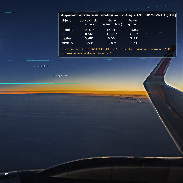
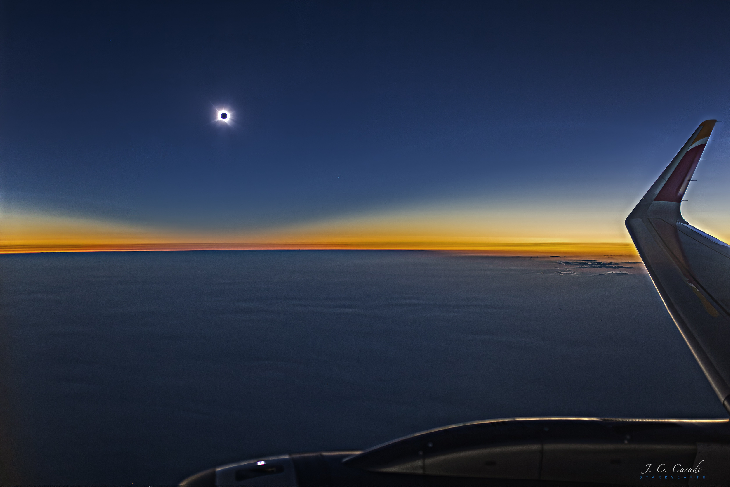
I send you this picture of the 12 August 2026 total solar eclipse, taken from on board Iberia flight IB1473, together with an annotated version showing the calculated and measured positions of the Sun, Regulus, Jupiter, Mercury, and the true astronomical horizon.
We consider this image particularly interesting because it provides an unusual opportunity to examine the geometry of a total solar eclipse from an airborne observing platform, while also allowing the apparent position of the horizon to be measured directly in the image. The eclipsed Sun, Regulus, Jupiter, and Mercury are all clearly recorded in the original image, and their apparent positions can be compared directly with their theoretical ephemerides.
One of the cameras installed on board the aircraft to intercept the Moon’s shadow captured this image of the Sun during totality, revealing a remarkably bright, pearlescent corona. This appearance contrasts with many ground-based images, in which the corona may acquire a noticeably redder cast as a result of atmospheric aerosols, haze, and wildfire smoke. Several celestial bodies close to the totally eclipsed Sun are also visible in the image.
The eclipse was photographed from Iberia flight IB1473, at an altitude of approximately 9,400 metres over Castilla y León, Spain. The annotated image shows the apparent altitudes of the Sun, the star Regulus, and the planets Jupiter and Mercury, together with the position of the true astronomical horizon.
By matching the four celestial bodies to their calculated positions and performing measurements directly on the original photograph, we find that the measured altitudes agree with the theoretical ephemerides to within only a few arcminutes.
The aircraft’s altitude is negligible compared with the immense distances to the Sun and the other celestial bodies. Its effect, however, is clearly apparent in the geometry of the horizon. From the aircraft’s position, the astronomical horizontal corresponds to 0° altitude, while the visible upper boundary of the atmospheric layer appears at approximately −2.28° below this horizontal reference.
The true geometrical horizon at the aircraft’s altitude lies approximately 2.91° below the astronomical horizontal. However, this horizon is not visible in the image because it is obscured by a layer of clouds, atmospheric haze, and wildfire smoke located approximately 3,600 metres above the ground and 270 kilometres from the aircraft. The upper boundary of this atmospheric layer appears at approximately −2.28°, about 0.63° above the true geometrical horizon corresponding to the aircraft’s altitude. Thus, the 0.63° difference represents the portion of the true horizon that is hidden from view by the intervening layer of clouds, haze, and smoke.
This provides an unusual visual demonstration of the effect of observing from an elevated platform: the distant celestial bodies retain essentially the same angular positions, while the apparent boundary of the Earth is displaced significantly below the true astronomical horizontal.
Flight and observational data
Flight: Iberia IB1473
Aircraft: Airbus A321XLR
Approximate flight altitude: 9,400 m
Location: Castilla y León, Spain
Approximate central point of the flight circuit: 42°21′ N, 4°12′ W
Totality observed from on board:
18:28:23–18:30:30 UT — 2 min 07 s
The astronomical ephemerides and the astrometric fit were calculated using the original, unprocessed image. The positions of the Sun, Regulus, Jupiter, and Mercury were used as independent reference points to assess the geometrical consistency of the photograph.
We believe that the combination of the total eclipse, the elevated observing position aboard the aircraft, the clearly defined atmospheric horizon, and the simultaneous recording of the eclipsed Sun, Regulus, Jupiter, and Mercury in the original image makes this a particularly unusual record of the 12 August 2026 total solar eclipse from an airborne platform.
Please find attached the original picture and the corresponding annotated version.
Best regards,
Photographer's website:
https://starryearth.com
|
|
|