Total Solar Eclipse August 12, 2026 from the air
Taken by Juan Carlos Casado on August 12, 2026 @
Palencia (Spain), above 11,000 meters
Click photo for larger image

| |
Camera Used: Unavailable Unavailable
Exposure Time: Unavailable
Aperture: Unavailable
ISO: Unavailable
Date Taken: 2026:08:16 11:14:57
|
|
| More images
Details:
I would like to present this image obtained during the total solar eclipse of August 12, 2026, photographed from Iberia flight IB1473, a specially chartered flight designed to observe and intercept the Moon’s shadow during totality.
After more than 30 years of observing solar eclipses around the world, our scientific expedition group SHELIOS faced a particularly anticipated event: for the first time in more than a century, a total solar eclipse was once again visible from mainland Spain.
However, the timing of the eclipse and the very low altitude of the Sun above the horizon made observation from the ground particularly challenging, due to the risks of clouds, storms, smoke, wildfires, atmospheric turbulence, and obstacles near the horizon. Drawing on our previous experience, including the total solar eclipse observed from Antarctica on November 23, 2003, we decided to approach the event from the air.
The proposal was made to Iberia by Dr. Miquel Serra-Ricart, Scientific Director of SHELIOS and of the eclipse flight. The objective was to place the aircraft above most of the atmosphere and, above all, to intercept the Moon’s umbral shadow and remain within it for as long as possible.
The trajectory was carefully calculated using the classical Besselian-element method, based on the Explanatory Supplement to the Astronomical Almanac and NASA’s Five Millennium Canon of Solar Eclipses, together with JPL planetary and lunar ephemerides. Lunar limb profiles obtained from the Kaguya/LRO missions were also taken into account. The aircraft was incorporated into the standard eclipse geometry at its actual cruising position, FL310, or 31,000 feet (9,449 m).
The resulting trajectory was designed as a “racetrack” pattern. After using first contact to synchronize and verify the predicted timing and position, the aircraft made the necessary turn to intercept the lunar shadow at second contact.
The calculation for flight IB1473 predicted the beginning of totality at 18:28:24 UT and the end at 18:30:30 UT, for an expected duration of approximately 2 minutes and 7 seconds. In practice, we intercepted the lunar shadow with an error of only about three seconds and experienced approximately 2 minutes and 8 seconds of totality. The atmospheric conditions were excellent, with very good visibility and virtually no turbulence.
The aircraft was also equipped with a high-speed Internet connection through the Starlink satellite network. This connectivity made it possible to broadcast the eclipse live from the aircraft, narrated by Dr. Miquel Serra-Ricart, the Scientific Director of the expedition, through the sky-live.tv platform. Thus, in addition to carrying out the scientific observation from the air, we were able to transmit the eclipse in real time from inside the aircraft.
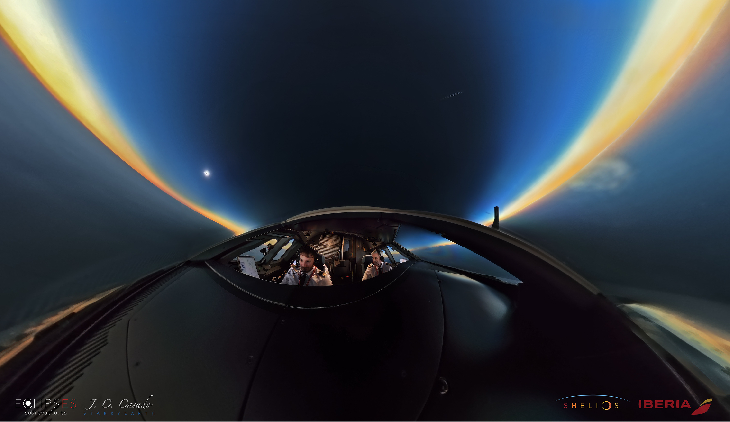
The image was captured with a 360-degree camera mounted with a suction cup at the front of the cockpit, next to the windshield. The camera was operated in video mode with settings optimized to preserve the maximum possible dynamic range.
Several frames corresponding to the central part of totality were subsequently selected and stacked to improve the signal-to-noise ratio and preserve information across the wide range of brightness present in the scene.
What makes this image particularly unusual is that it allows the eclipse to be seen from inside the aircraft itself. In a single scene, the cockpit and crew, the nose of the Airbus A321XLR, the fully eclipsed Sun, Venus in the upper-left part of the sky, and the darkness of the Moon’s umbral shadow projected across the atmosphere and the aircraft can all be seen simultaneously. Around the umbra, the horizon remains illuminated by sunlight reaching the regions outside the shadow, creating a striking transition between the darkness of totality and the still-illuminated atmosphere.
Another aircraft can also be seen crossing the region of totality. We have not yet been able to identify it; unlike IB1473, it was not deliberately following the movement of the lunar shadow.
The aircraft was specially chartered by Iberia and was an Airbus A321XLR, one of the airline’s newest aircraft, with a range of almost 10,000 km. The flight number, IB1473, was chosen in reference to the birth year of Nicolaus Copernicus.
We believe that this image is more than a record of a total solar eclipse. It documents a carefully planned astronomical and aeronautical operation and brings together, in a single frame, the eclipse, the Moon’s shadow, the illuminated Earth’s atmosphere, the aircraft from which the observation was made, and the people who made this experience possible.
Photographer's website:
https://starryearth.com
|
|
|