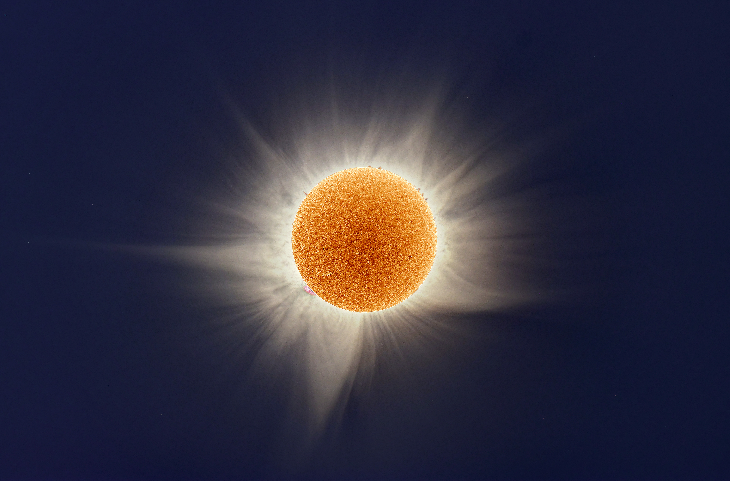
Multilayer Sun
Taken by Javier Manteca on August 12, 2026 @
Valoria la Buena, Valladolid, Spain
Click photo for larger image

| |
Camera Used: Canon Canon EOS 90D
Exposure Time: 5/2
Aperture: f/8.0
ISO: 100
Date Taken: 2026:08:16 18:00:08
|
|
| More images
Details:
My name is Javier Manteca, an amateur solar observer from Madrid, Spain.
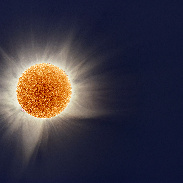
I would like to show a composite solar image (Image 1) created from two independent datasets obtained during the total solar eclipse of 12 August 2026, observed from Valoria la Buena, a small municipality near Valladolid, Spain (41.823° N, 4.511° W), located within the path of totality.
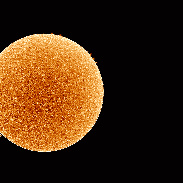
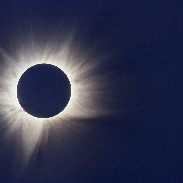
The image integrates high‑resolution H‑alpha chromospheric data (Image 2) acquired minutes before first contact with a dedicated solar telescope, together with a multi‑exposure HDR sequence of the white‑light corona (Image 3) captured during totality. It is a complete representation of the Sun, something no instrument in the world can capture in a single exposure. This combination produces a scientifically coherent multi‑layer visualization of the solar atmosphere, showing simultaneously the fine structure of the chromosphere and the extended morphology of the corona. It shows two distinct solar layers that are never visible together in reality.
The chromosphere (Image 2) was recorded five minutes before first contact (C1) using a Lunt LS50 solar telescope equipped with an H‑alpha etalon and narrow bandpass, together with a monochrome ZWO ASI178MM camera. This configuration allows high‑spatial‑frequency chromospheric structures to be resolved, including filaments, fibrils, active regions, and prominences, with sampling appropriate for the instrument’s aperture.
The corona (Image 3) comes from an HDR sequence acquired during totality using a Canon 90D coupled to a Tamron 150–600 mm G2 lens operating at 600 mm (equivalent to 960 mm on APS‑C), ISO 100, and f/8. A total of 21 consecutive exposures were recorded, ranging from 1/2500 s to 4 s in 2/3 EV increments, covering a dynamic range sufficient to simultaneously represent the inner corona, the mid‑range streamers, and the outer extensions. Its brightness is thousands of times lower than that of the photosphere. The sequence was aligned and merged to preserve the radial structure and brightness distribution of the white‑light corona during totality.
A detailed technical description of the acquisition process is included in the submission, along with two tables summarizing the capture parameters for both datasets:
H‑alpha dataset: Lunt LS50 + ZWO ASI178MM, 86 frames, 1.0 ms exposure, gain 160, MONO8, 3096×2080 px, 18.55 fps.
Corona dataset: Canon 90D + Tamron 150–600 mm G2, 21 HDR exposures from 1/2500 s to 4 s in 2/3 EV increments, ISO 100, f/8.
The purpose of this submission is to present a scientifically accurate visualization of the solar atmosphere across multiple layers, combining narrowband chromospheric imaging with broadband eclipse photography.
Thank you very much for your time.
Sincerely,
Javier Manteca
Madrid, Spain
tasico.es@hotmail.com
Photographer's website:
https://www.tasico.es
|
|
|