Satellite Strewn Sky
Taken by Alan Dyer on June 14, 2026 @
near Gleichen, Alberta, Canada
Click photo for larger image

| |
Camera Used: Unavailable Unavailable
Exposure Time: Unavailable
Aperture: Unavailable
ISO: Unavailable
Date Taken: 2026:06:15 10:23:22
|
|
| More images
Details:
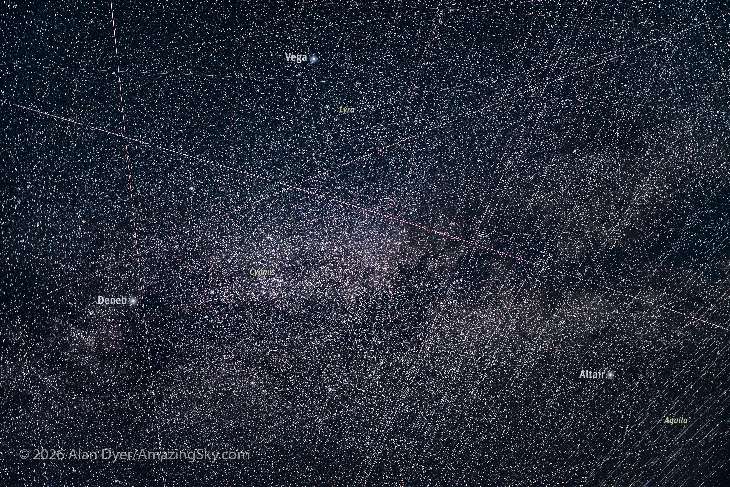
This is an accumulation of exposures showing the number of satellites passing across the summer Milky Way during just 35 minutes on a summer night.
This was from 12:28 am to 1:03 am on June 14, 2026. The field of view here is 54º by 37º. The field frames the three stars of the Summer Triangle: Deneb at left, Vega at top, and Altair at lower right, in Cygnus, Lyra and Aquila respectively.
This was shot from my location in southern Alberta at 51º North latitude. That latitude range is the worst (!) for seeing satellites in abundance as:
a) in summer around the solstice even satellites in low Earth orbit are lit by sunlight all night long, and
b) many sets of Starlink satellites peak at the most northerly point in their inclined orbits at about my latitude.
And yes, most of the satellite trails are from SpaceX Starlink satellites as most of the satellites now in orbit are Starlinks. And most seen here are following similar parallel paths as Starlinks sets do.
The fast lens and long exposures I used here do make satellites visible that were too faint to see with the unaided eye, just as fainter stars than your eye can see are recorded. Nevertheless, this shows just how many satellites are now passing through any field of view, be it naked eye, camera lens, or telescope.
For this I stacked just 300 frames out of 1200 I shot this night over 2h30m. Stacking more frames only produced a dense, chaotic mess, with so many satellite trails the stars were hidden behind a wall of bright streaks.
Technical:
This is a stack of 300 frames, stacked using the program StarStax using the Lighten blend mode, to add the satellite trails rather than average them out.
Each exposure was 6 seconds at f/1.2 with the Viltrox 35mm LAB lens on the Nikon Z8 at ISO 1600. (StarStax deleted the camera metadata from the files.) There was an interval of 1 second between exposures, thus the gaps in all the trails. The camera was on a tracker following the turning sky, so the stars stay fixed on the frame with minimal trailing, and the satellites streak against the point-like stars.
Photographer's website:
https://amazingsky.com
|
|
|