| More images
Details:
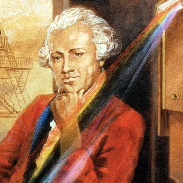
It is at a distance of approximately 2000 light years.It was discovered by William Herschel
in 1793
https://en.wikipedia.org/wiki/William_Herschel
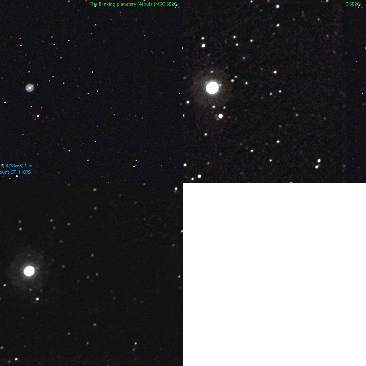
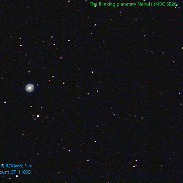
The "Blink" Effect: This is a visual trick involving the biology of our eyes.
The central star is very bright, so when we look at it, we can't see
the faint outer nebula. Looking beside it, (using "averted vision") brings the more
sensitive peripheral rods in to use, making the bluish-green gas visible.
https://en.wikipedia.org/wiki/NGC_6826
Time: 22:49UT 2026-05-26 Filter & Exp. R(8x30) G(5x65) B(18x65) Sec
H Alpha(25x185) , O III(18x185) Sec
Tel: C14 @ f/4.1 ST-7 CCD @ -18°C 1.28"/pix Paramount GT-1100S
Odd Trondal Obs.code 238 (Uranium). Oslo Norway.
I also used H-Alpha & O III filter in the animation (O-III is emission from thin O++ plasma), and remember "Physics is everything" ref. Don Lincoln
Software used:TheSky6,CCDSoft 5, MSB Astroart 2.0, 8.0, Paint
Previous Planetary Nebulae images :
The Cat's Eye Nebula, NGC 6543 in Draco
Planetary nebula M 57 in Lyra
The small ring nebula in the constellation Lyra
A planetary nebula in the constellation Cepheus
Photographer's website:
https://www.flickr.com/photos/odd_trondal/
|