AR4392
Taken by Pepe Manteca on March 20, 2026 @
Begues
Click photo for larger image

| |
Camera Used: Unavailable Unavailable
Exposure Time: Unavailable
Aperture: Unavailable
ISO: Unavailable
Date Taken: 2026:03:20 13:51:20
|
|
| More images
Details:
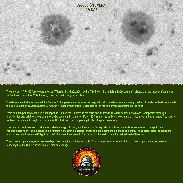
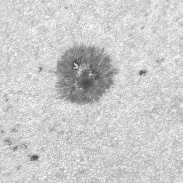
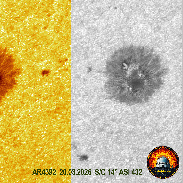
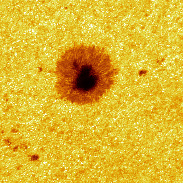
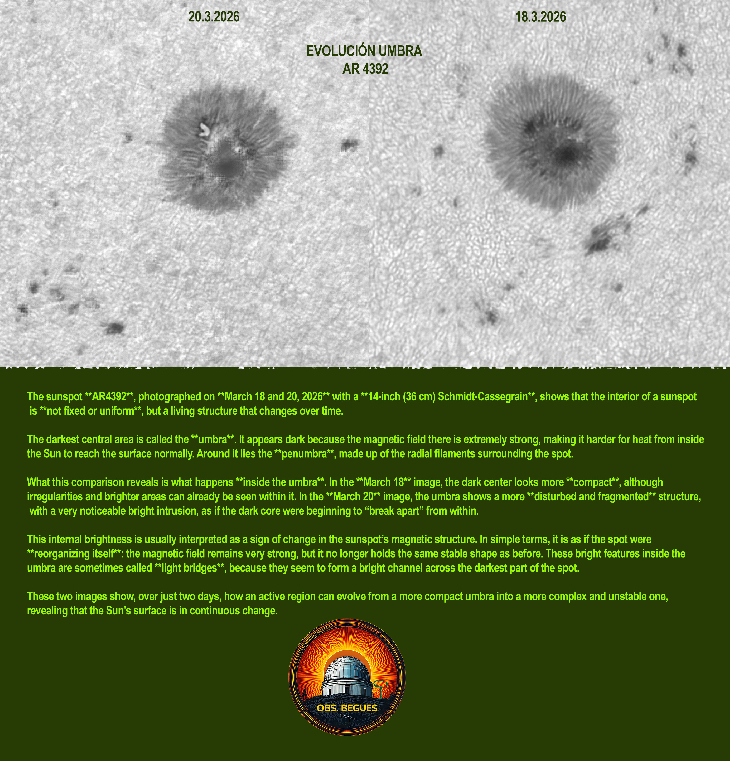
The sunspot **AR4392**, photographed on **March 18 and 20, 2026** with a **14-inch (36 cm) Schmidt-Cassegrain**, shows that the interior of a sunspot is **not fixed or uniform**, but a living structure that changes over time.
The darkest central area is called the **umbra**. It appears dark because the magnetic field there is extremely strong, making it harder for heat from inside the Sun to reach the surface normally. Around it lies the **penumbra**, made up of the radial filaments surrounding the spot.
What this comparison reveals is what happens **inside the umbra**. In the **March 18** image, the dark center looks more **compact**, although irregularities and brighter areas can already be seen within it. In the **March 20** image, the umbra shows a more **disturbed and fragmented** structure, with a very noticeable bright intrusion, as if the dark core were beginning to “break apart” from within.
This internal brightness is usually interpreted as a sign of change in the sunspot’s magnetic structure. In simple terms, it is as if the spot were **reorganizing itself**: the magnetic field remains very strong, but it no longer holds the same stable shape as before. These bright features inside the umbra are sometimes called **light bridges**, because they seem to form a bright channel across the darkest part of the spot.
These two images show, over just two days, how an active region can evolve from a more compact umbra into a more complex and unstable one, revealing that the Sun’s surface is in continuous change.
Photographer's website:
https://youtube.com/live/ktpDdrpzCgc?feature=share
|
|
|