Planetary Nebula M76 in Perseus
Taken by Tom Wildoner on October 26, 2025 @
Weatherly, PA, USA
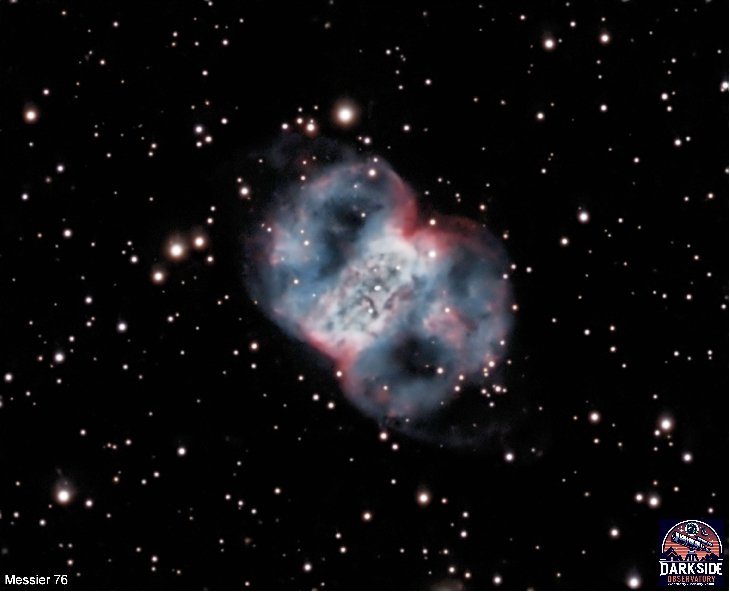
Click photo for larger image

| |
Camera Used: Unavailable Unavailable
Exposure Time: Unavailable
Aperture: Unavailable
ISO: Unavailable
Date Taken: 2025:12:21 08:37:15
|
|
| More images
Details:
Messier 76 (M76), also known as the Little Dumbbell Nebula and NGC 650 and NGC 651, is a planetary nebula located in the constellation Perseus, about 2,500 light-years from Earth. It formed when a dying, Sun-like star shed its outer layers into space, creating a glowing cloud of gas illuminated by the hot central stellar remnant. M76 has a distinctive double-lobed shape, which is why it resembles a smaller version of the Dumbbell Nebula (M27). It is one of the faintest objects in the Messier catalog, making it a challenging but rewarding target for astronomers, and it provides valuable insight into the late stages of stellar evolution.
Observation data: J2000.0 epoch
Right ascension: 01h 42.4m
Declination: +51° 34′ 31″
Distance: 2500 ly
Apparent magnitude (V): +10.1
Apparent dimensions (V): 2.7 × 1.8 arcmin
Constellation: Perseus
Physical characteristics: Radius 0.617 ly
Tech Specs: Meade 12” LX-90 SCT Telescope, Antares Focal Reducer, ZWO ASI2600MC camera running at -10F, 162 x 60 seconds, Celestron CGX-L pier mounted, ZWO EAF and ASIAir Pro, processed in DSS and PixInsight. Image Date: October 26, 2025. Location: The Dark Side Observatory (W59), Weatherly, PA, USA (Bortle Class 4).
Photographer's website:
https://www.thedarksideobservatory.com
|
|
|