| More images
Details:
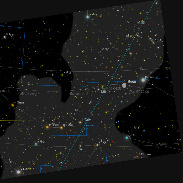
This month is the first time in over 1.5 years that the Moon at its northernmost point in the sky completely missed being anywhere inside the constellation Auriga. This means that northern lunar standstills are starting to move back south towards the ecliptic, i.e. be lower in the sky. (On the map the ecliptic is the yellow line running left to right below the Moon, and the wavy line through the Moon is its path in the sky.) However, in the next few months there are still a few grazing incidents left with Auriga before the Moon is so far south that it'll never enter it again during the current saros cycle. That will happen in May 2026, according to the simulations in my planetarium program.
Note the timings given in the paragraph above depend on your latitude. Places farther south than I am at 37° N. (say, at the equator or below) are still having Auriga encounters, but eventually those will stop for southerners too.
Images:
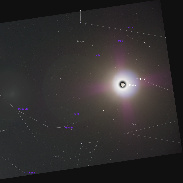
#1: photo of the Moon (about midnight) shortly before reaching its northernmost declination for the month (about 4am with dawn at 5:30am)
#2: map from Sky Safari Pro v.6 matching the photo's field of view
Photo data:
Panasonic GX8, Lumix 12-35mm lens @ 35mm, photo tripod
... stars: 6 x (f/2.8, 1.6 sec, ISO 800) = 9.6 sec
... moon: 1 x (f/5.6, 1/1000 sec, ISO 800)
... N up W clockwise; FOV: 27° x 21°
... stacked: Deep Sky Stacker; processed: Paint Shop Pro 2023
... lunar standstill simulations run in Sky Safari Pro v.6 on an iPad Pro
... date: Nov. 7, 2025 11:40pm MST
Photographer's website:
No URL provided.
|