| More images
Details:
It was discovered by Max Wolf on 11 September 1898 at the University of Heidelberg. It was named after Hungary, which hosted an astronomical meeting in 1898 in Budapest.
https://en.wikipedia.org/wiki/434_Hungaria
Hungaria orbits the sun every 991 days (2.71 years), coming as close as 1.80 AU and reaching as far as 2.09 AU from the sun. Hungaria is about 8.9 kilometers in diameter, making it larger than 99% of asteroids, comparable in size to the San Francisco Bay.
The rotation of Hungaria has been observed. It completes a rotation on its axis every 26.52 hours.
Hungaria's spectral type E (Tholen) / Xe (SMASSII) indicates that it is likely to contain iron, nickel, and cobalt.
https://www.spacereference.org/asteroid/434-hungaria-a898-rb
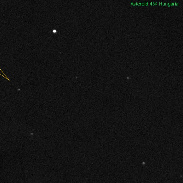
Time: 22:29UT 2025-06-19 Exp. 13 x 30 sec.
Telescope 0.254m f/6 ST-10XME CCD -15°C 0.9"/pix
Odd Trondal Obs.code 238 (Uranium). Oslo Norway.
Software used:TheSky6,CCDSoft 5, MSB Astroart 2.0, 8.0, Paint
Photographer's website:
https://www.flickr.com/photos/odd_trondal/
|