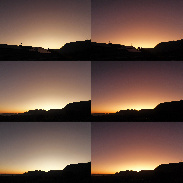
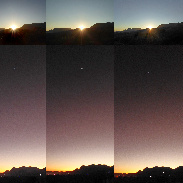
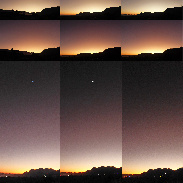
Three Early and Late Volcanic Sunsets, 5-7th May
Taken by Peter Lowenstein on May 5, 2025 @
Mutare, Zimbabwe
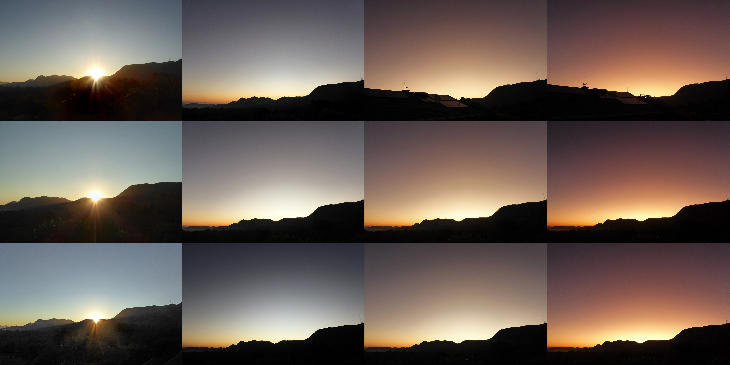
Click photo for larger image

| |
Camera Used: Panasonic DMC-TZ60
Exposure Time: 10/20000
Aperture: f/8.0
ISO: 160
Date Taken: 2025:05:13 19:43:27
|
|
| More images
Details:
This introduction and the following three posts record the presence of early and late volcanic sunset twilight arches which developed and receded under very similar good seeing conditions on three consecutive days on 5th, 6th and 7th of May. They demonstrate that almost three-and-a-half years after the massive Hunga-Tonga eruption in mid-January 2022 there are still sufficient quantities of volcanic aerosols (particles) in the stratosphere to produce spectacular optical effects which can be observed from this location (Mutare) during the hour and a quarter following sunset on nearly every day on which the weather is clear enough to permit an uninterrupted view of the sunset horizon! What is of particular interest is that the displays involve the development and receding of both early brightly colored and then later fainter higher pastel shade volcanic sunset twilight arches. The former appear to originate from the lower stratosphere and the latter from higher portions and possibly the mesosphere above. Whereas the bright colors are obvious to the naked eye, the pastel shades are only clearly visible in camera images taken using long (more than I second) exposures with high ISO (sensitivity) settings. Despite having reported this on numerous occasions in the past three years no feedback has been forthcoming on my observations! What is interesting is that the glow from the late volcanic sunset twilight arches can extend almost to the zenith and include high planets and constellations of stars that would normally be in complete darkness an hour after sunset. The composite images accompanying this introduction show both the direct sunsets and subsequent early and late volcanic sunset twilight arches on the 5-7th May and illustrate that the late twilight arches initially extend almost up to the bright star Sirius in the Canis Major constellation! Camera: Tripod-mounted Panasonic Lumix DMC-ZS40 in sunset and manual exposure modes
Photographer's website:
No URL provided.
|
|
|