Planets' colours
Taken by PAOLO PALMA on December 30, 2024 @
Naples - Italy
Click photo for larger image

| |
Camera Used: Unavailable Unavailable
Exposure Time: Unavailable
Aperture: Unavailable
ISO: Unavailable
Date Taken: 2025:01:03 16:45:43
|
|
| More images
Details:
With the exception of Uranus and Neptune, the other 5 planets are among those few dozen 'stars' that clearly show their respective hues already with the naked eye.
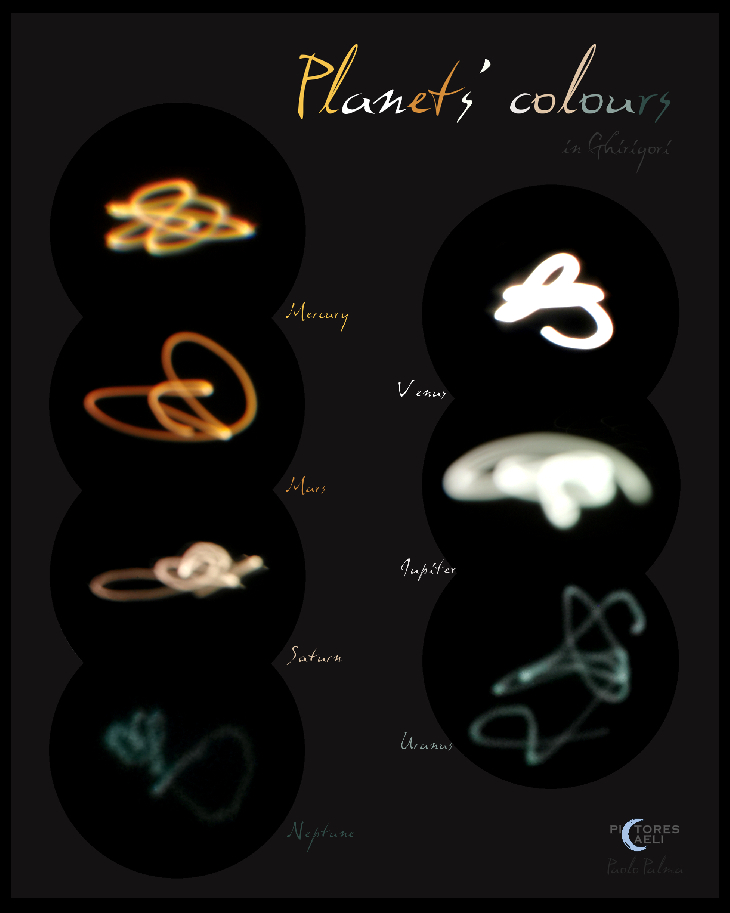
But after having photographed the 20 brightest stars in the sky ( spaceweather 18 november 2022 ) and dozens and dozens of telescopic stars in the form of Ghirigori ( that is scribbles by shocking the telescope - APOD 12 august 2023 ) in order to better appreciate and compare their nuances, I could not but use this technique with the planets as well, especially these days as they are all far from the Sun and thus in a favourable position to be observed and filmed even in the space of a single night.
Through a large-diameter telescope and at high magnifications, their colours appear much more intense than by mere sight.
And by shaking them in the eyepiece field, the different nuances of the various details visible on their surface - such as the bands and storms of Jupiter, or the polar cap and the Martian chiaroscuro - blend and blend better with each other and return a nuance as close as possible to the combination of the different parts, which not even a simple 'in focus image' would obviously be able to give.
By putting them together in a single mosaic, they can be better compared with each other, so that we can notice the differences - hardly noticeable - between the shades of Venus and Jupiter and between those of Saturn and Mercury, and appreciate instead the unexpected similarity between those of Uranus and Neptune, just as a study by Oxford University has recently shown: https://shorturl. at/07lAR
As with stars, their colours tell us something objective about the individual planets: both about the composition of the atmospheres of the gas giants, and about the soil of Mars and the atmosphere of Venus.
N.B. For the occasion, the moon that serves as the C in the PictoreCaeli logo has a new shade of blue: I have in fact 'borrowed' it from the famous Pale blue Dot image of NASA taken by the Voyager 1 spacecraft in 1990 and in which our small Earth, photographed at a distance of some 6 billion km, shows its pale, singular blue hue: https://shorturl.at/iekAl
In this way, the colour of the Earth, as it appears from space, is also in this mosaic.
Photographer's website:
https://www.unsaltonelcielo.it
|
|
|