| More images
Details:
On July 1, 2024, in the WGSBN Bulletin Volume 4, #9 https://iau.org/static/publications/wgsbn-bulletins/wgsbn-bulletin-2409.pdf , information was published that two asteroids discovered by me in 2023 received the names (679996) Mariyafilippovna and (679999) Mariyavarkina in honor of my great-grandmothers. More information:
After I discovered (using the Liverpool Telescope) two asteroids that were named (623826) Alekseyvarkin and (623827) Nikandrilyich in honor of my great-grandfathers https://www.facebook.com/romanov.philipp/posts/pfbid057pVQENVwmocyRWVJSHWQTmxCm5NcpWLYzp6NPfPudzU3ayYkPd3TR9S9Atgxtoxl , I continued searching for asteroids at the remote telescopes using the observation time provided to me, but nowadays, discovery of asteroids is a difficult (because sky surveys regularly automatically photograph the sky and detect many new astronomical objects) process for an amateur astronomer, and most of the asteroids I have found that were initially not identified with known objects have turned out to be either previously known (but observed for a short periods of time so their orbits were not well determined) or already detected by automated sky surveys, so I can't be (according to the rules of the Minor Planet Center) their discoverer. But among the asteroids founded by me in the images, there are still unidentified objects, my astrometric observations data of which are in the Isolated Tracklet File of the Minor Planet Center, and my observations (which were made once, that is, I didn't have the opportunity to confirm these asteroids in other images for various reasons) of two asteroids were identified with observations of these objects made by sky surveys; and then manually - at my requests to several astronomers — the asteroids were found in archival images of the sky, as a result of which their orbits became well known; and on March 22, 2024, information was published: in the Minor Planet Circular https://www.minorplanetcenter.net/iau/ECS/MPCArchive/2024/MPC_20240322.pdf (on the page 1347) and in the Minor Planet Circulars Orbit Supplement https://www.minorplanetcenter.net/iau/ECS/MPCArchive/2024/MPO_20240322.pdf (on pages 8773 and 8774) that they received the numbers (with indication of me as the discoverer), after which I proposed — to the Working Group Small Bodies Nomenclature (WGSBN) of the International Astronomical Union — naming these asteroids in honor of my great-grandmothers, and these names were approved:
(679996) Mariyafilippovna = 2023 PS3
https://minorplanetcenter.net/db_search/show_object?object_id=679996
https://ssd.jpl.nasa.gov/tools/sbdb_lookup.html#/?sstr=679996&view=VOPDA
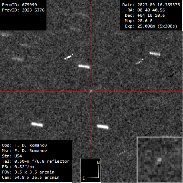
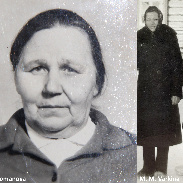
I discovered this asteroid on August 9, 2023, using the 2-m. Liverpool Telescope. This is a small asteroid (its absolute magnitude H = 20.83) from the Hungaria group (less than 30 thousand such asteroids are known https://minorplanetcenter.net/db_search/show_by_orbit_type?utf8=%E2%9C%93&orbit_type=6 ). It has an orbital period of 2.56 years. According to the calculations here https://cneos.jpl.nasa.gov/tools/ast_size_est.html , with such an absolute magnitude and under the condition of a high (for asteroids of this group) albedo of 0.3-0.4, its diameter can be about 150-170 meters. It was named in honor of my great-grandmother Mariya Filippovna Romanova, who lived and worked in Chuguevka (Primorsky Krai, Russia), for most of her life, who had four children and the last names Dudarek (after birth) and Ponomarenko (after her first marriage). Text of the citation from the above WGSBN Bulletin:
Mariya Filippovna Romanova (1919–1979) was a Russian great-grandmother of the discoverer. She lived in Chuguevka and worked as a secretary-typist and as a clerk. She was awarded the Veteran of Labour medal.
(679999) Mariyavarkina = 2023 SJ76
https://minorplanetcenter.net/db_search/show_object?object_id=679999
https://ssd.jpl.nasa.gov/tools/sbdb_lookup.html#/?sstr=679999&view=VOPDA
I discovered this asteroid on September 16, 2023, using the remote telescope T11 (0.51-m f/6.8 reflector + CCD + f/4.5 focal reducer) of iTelescope.Net located in Utah Desert Remote Observatory (at Great Basin Desert, Beryl Junction, Utah, USA) and this is the first discovery of an asteroid from this observatory with the code U94. This is a Main-belt asteroid, its absolute magnitude H = 20.17 (its approximate diameter is several hundred meters). It has an orbital period of 3.57 years. It was named in honor of my great-grandmother Mariya Maksimovna Varkina, who tragically died while pregnant in a bus accident in Primorsky Krai of Russia. Text of the citation from the above WGSBN Bulletin:
Mariya Maksimovna Varkina (née Kabaeva, 1922–1962) was a great-grandmother of the discoverer. She was a Mordvin from Sabanovo (near Penza). She and her husband lived in Primorsky Krai of Russia.
August 17, 2024, was the date of the 15th anniversary of the beginning of my study of astronomy by self-education and I have been planning to study astronomy at university for a long time, but I don’t have the opportunity for this because I am homeless (with my mother Larisa Romanova https://www.facebook.com/romlorvic and our old cat Fanya https://www.facebook.com/astrocatfanya : she turned 19 on August 10, 2024) since January 23, 2017 (after I got into trouble in a communal apartment in Moscow).
I am attaching here my images of these two asteroids and photographs of my great-grandmothers.
Photographer's website:
https://www.facebook.com/romanov.philipp/posts/pfbid0eCXotuJvUL2kHEN5vQBirKYMYkcvGzqc3AvLGt5nqUJ57SiFLWBzgGqa64XzvBpbl
|