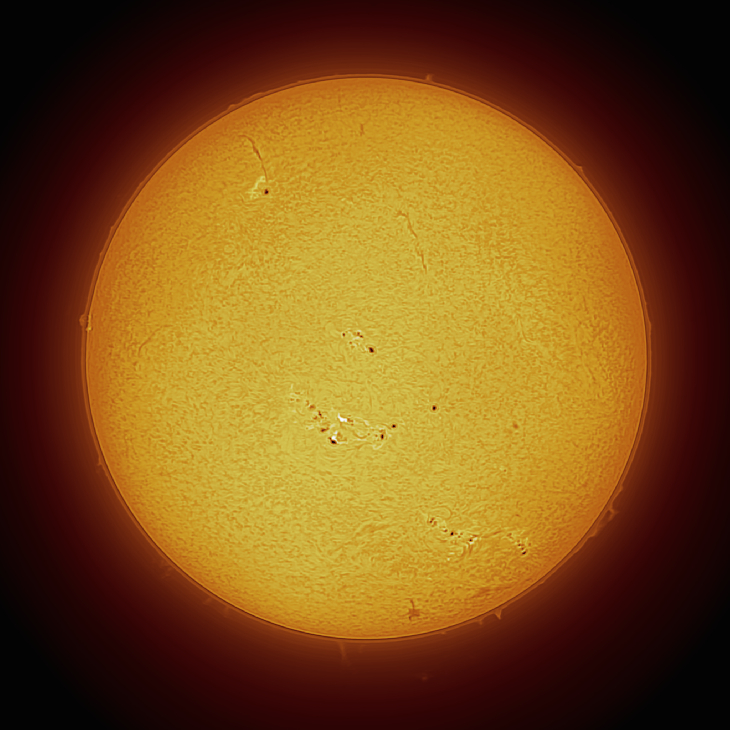
Solar chromosphere with flare
Taken by Sighard Schraebler on July 29, 2024 @
Karben, Germany
Click photo for larger image

| |
Camera Used: Unavailable Unavailable
Exposure Time: Unavailable
Aperture: Unavailable
ISO: Unavailable
Date Taken: 2024:07:30 10:21:39
|
|
| More images
Details:
Chromosphere from July 29, 2024 5:22 p.m. CEST
This is a (colored) view of the outer layer of the sun in the light of the H-alpha line, in which prominences and filaments become visible. Flare (bright eruption) from yesterday afternoon. A loop comes out of the sun, it becomes very bright, bursts open, shoots a large package of solar wind in our direction. 3-inch Pentax refractor 75SDHF, energy protection filter, Quark Chromosphere narrowband filter, A7s, approx. 7 minutes of solar film, 50fps, ISO 640. That means making one image from over 20,000 images in 25 fields each with 6 runs. Averages say more than individual values.
At the bottom of the image you find another packet of solar wind, but it is drifting away in a different direction at well over 2000 km/s. It is difficult to imagine a region in which the magnetic fields are so strong that particles can only move along the magnetic field lines. Things get exciting when the north pole and south pole come close to each other on the surface, then the conditions are right for break off and a package can be hurled away. The current density rises rapidly before this, which is why the flare is so bright. The drive is the differential rotation of the sun, which winds up field lines like Spaghetti with a fork. And at some point the field lines have to break off.
Between July 27 and July 29, 2024, a series of coronal mass ejections (CMEs) occurred, leading to a significant solar storm. The event began on July 27, when two closely-spaced CMEs merged shortly after leaving the sun, creating a "cannibalized" front that traveled toward Earth. On July 28, a third CME followed, easily catching up to the first two. A fourth CME was expected to combine with the others after passing Earth on July 29. This sequence of CMEs snowplowed the solar wind ahead of them, amplifying the potential impact on Earth’s space weather.
https://spaceweather.com/images2024/30jul24/cannibal.gif
Photographer's website:
https://www.sternwarte-hofheim.de/galerie/schraebler/album/
|
|
|