| More images
Details:
On June 20th the Sun reached summer solstice, where it stops its march northward in the sky and starts heading south ("solstice" means "solar standstill"); on that day when crossing the meridian it's at its highest point in the sky, so any shadow it casts then will be the shortest such one for the year.
The Moon does similar things, except monthly. When it changes direction in the sky at its north or south end it's called a "lunar standstill", or "lunistice". However, the Moon's orbit is tilted 5° relative to the ecliptic and also wobbles around the Earth in an 18.6-year period (called the "saros") due to precession, complicating the timing and positions of such events. The phase of the Moon needs to be considered, too: if it reaches its maximal south point at New Moon, say, it would technically meet the criteria for a standstill but go unseen--rather unsatisfying. That might actually be the case this time around; what I've read so far from various web sources indicate the absolute maximal value will occur in January 2025 when the Sun is in Sagittarius, obliterating any chance of seeing the Moon at its farthest southern point there with it.
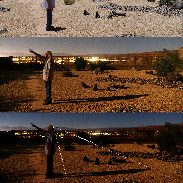
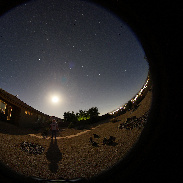
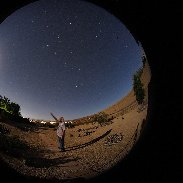
Given all that, the "Full Moon nearest maximal southern standstill in the current saros cycle" occurred last night on the day after the summer solstice, putting it as low to the southern horizon as it ever gets; hence when it crossed the meridian any shadow cast by it was at its longest. The first picture compares the difference in shadow lengths cast by the Sun and Moon when they were on the meridian and gives their respective angular heights above the horizon. The fisheye photos show the setup.
The next paragraph contains some simple math; feel free to skip over it. The Sun cast a shadow at a 75.5° angle to the horizontal, so the Sun was 90° - 75.5° = 14.5° from the zenith, while the true value was 13.75°. The Moon was 23.5° above the horizon; my latitude of 37° N implies a southern-horizon declination value of -53°, so -53° + 23.5° = -29.5° for the Moon's declination in the sky, while the true value was -29.16°. Both values as measured from the photo are within a degree of their true values in the sky--not bad. Also, the Moon's shadow measured at 7.6x longer than the Sun's shadow.
(Measured angles provided by the graphics editor program; true values from Sky Safari Pro 6.)
Photos:
#1: Shadows cast by Sun and Moon when at the meridian
#2: Moon, me, shadow, and camera lined up with the meridian
#3: View from the side
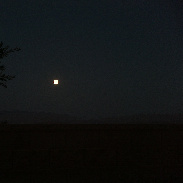
#4: Moon at dawn
Photo data:
Panasonic GX8, Laowa 4mm-fisheye & Lumix 12-35mm lenses
... sun: (12mm, f/9, 1/1000 sec, ISO 200)
... moon: (12mm, f/2.8, 8 sec, ISO 400)
... fisheye exposures: (4mm, f/2.8, 15 sec, ISO 400)
... moon at dawn: (35mm, f/2.8, 1/250 sec, ISO 800)
... processed in Paint Shop Pro
... date: June 21-22, 2024
Photographer's website:
No URL provided.
|