| More images
Details:
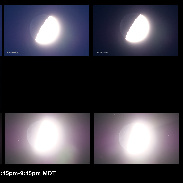
Four Moon-related things happened Sunday night (Mar 17th): 1/ it occulted a (faint) naked-eye star 2/ it was as far north in the sky (maybe) as it can get 3/ it was totally inside the non-Zodiac constellation of Auriga 4/ it crossed the meridian while doing the other three, assuming you wanted to break your neck viewing the events overhead. There's an image for each event (with overlap): #1/ the occultation #2/ being maximally north in Auriga #3/ being overhead on the meridian. For details (including the timeline and photo settings) keep reading, else skip the rest for the pretty pictures.
The Moon occulted the mag 6.1 star 54 Aurigae Sunday night (Mar 17th), which disappeared at 8:15pm MDT (near the beginning of nautical twilight) and reappeared at 9:45pm MDT (at night). In the occultation sequence image (#1) each frame was shot using 3-stop bracketing and the clearest one used; the star's disappearance at the dark limb was readily seen and even recorded during one such 3-shot bracket. Its reappearance was of course lost in the Moon's glare; in the successive 2 frames I added tick marks to show its position in the glare.
At 8:30pm MDT the Moon began crossing the Gemini/Auriga border into Gemini, and finally got past it at 10:00pm MDT, taking 1.5 hours to travel its own diameter in the sky. At the same time as it began its crossing into Gemini it also crossed the meridian.
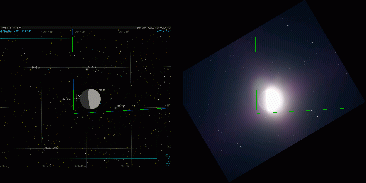
The animated map/photo image (#2) shows one moment during the occultation. The area had many stars waiting their turn for occultation (e.g. 25 Gem is just east of and very similar to 54 Aur); the star you see in this photo on the edge of the Moon is not 54 Aur (it's already behind the Moon) but a mag 9 star 6' north of it (HD 261182). The map shows the Moon's position for 8:00pm MDT while the photo shows it for 8:24pm MDT. I would have preferred to have had map and photo for the same time, except the sky was still too bright to see any stars at 8:00pm MDT, but by 8:07pm MDT the target star had become faintly discernible to the camera.
The map also shows that the Moon during this time was totally inside Auriga. I was under the impression that the Moon couldn't be seen completely inside Auriga's borders at my latitude (37°N) , but the proof is here that it can. The Moon isn't always so far north. Since the Moon's orbit is inclined 5° to the ecliptic, its northernmost point (aka northern "lunar standstill" or "lunistice") can vary by up to 10°. This year it is near its maximal high (I think actual max occurs next January--I have yet to see a definitive statement about when exactly it is), where Auriga is the constellation just above the northernmost point of the ecliptic (its minimal high is on the other side of the ecliptic in Orion inside his club).
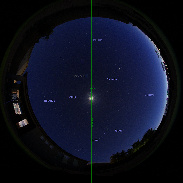
The fisheye image (#3) shows the Moon as it crossed the meridian at 8:30pm MDT when it was 8° 51' south of the zenith.
Photos:
#1: progress of occultation
#2: map & photo animated GIF
#3: Moon overhead in fisheye view
Astro data:
Sky Safari Pro 6 for the iPad, including the map; all times are MDT
... sunset: 7:44pm
... civil twilight ends: 8:09pm
... occultation of 54 Aur (mag 6.1): 8:15pm-9:45pm
... Moon crossing Gem/Aur border: 8:30pm-10:00pm
... Moon crosses the meridian: 8:30pm
... nautical twilight ends: 8:39pm
... night begins: 9:10pm
... occultation of 25 Gem (mag 6.4): 9:26pm-10:51pm (no photos, but it was mentioned)
Photo data:
occultation shots: Panasonic G9, Lumix 100-300mm lens @ 250mm, iOptron SkyTracker Pro
... (f.5.3, 1/5-5 sec, ISO 400)
... date: Mar 17, 2024 8:07pm-10:46pm
photo in animated GIF: same equipment as above
... (f/5.3, 5 sec, ISO 400)
... animation done in SSuiteGIFAnimator3
... date: Mar 17, 2024 8:24pm
fisheye shot: Panasonic GX8, Laowa 4mm fisheye lens, camera laid flat on tabletop
... (f/5.6, 10 sec, ISO 400)
... N up W right
... date: Mar 17, 2024 8:37pm
Photographer's website:
No URL provided.
|