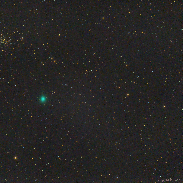
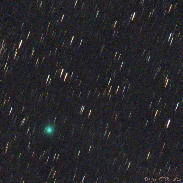
C/2023 P1 Nishimura Comet
Taken by Uğur İkizler on August 22, 2023 @
Mudanya - Bursa - Turkiye
Click photo for larger image

| |
Camera Used: Unavailable Unavailable
Exposure Time: Unavailable
Aperture: Unavailable
ISO: Unavailable
Date Taken: Unavailable
|
|
| More images
Details:
C/2023 P1 (Nishimura) is a comet with a short 6-day observing arc, and the initial orbit indicates it will orbit the Sun in a few hundred years. It was discovered by Hideo Nishimura on August 12, 2023, when the comet was at a distance of 1.0 AU from the Sun using the 200mm f/3 telephoto lens mounted on the Canon EOS 6D. The comet is less than 50 degrees from the Sun since April 2023.
The discovered comet was in the sky at dawn and was approaching the Sun. It is possible that in the first days of September it will be bright enough to be observed with binoculars before sunrise. It will pass at a distance of AB (126 million km), but only 15 degrees from the Sun's glare. Then, 5 days later, on September 17, 2023, it will come to the perihelion point (the closest position to the Sun) at a distance of 0.22 AU from the Sun. The comet will be briefly visible in the evening sky in mid-September and will be 5 degrees above the horizon 30 minutes after sunset at 35° north latitude. Although the comet can reach apparent magnitudes of around +2 to the naked eye, it can be difficult to locate against the Sun's glare.
Source: https://en.wikipedia.org/
The period of Nishimura, seen these days in the constellation Gemini, was calculated as 299 years. Orbital speed is 46.86 km/s.
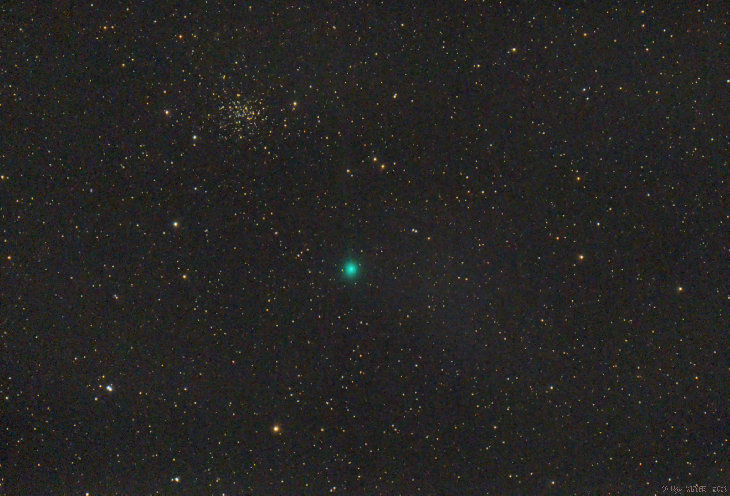
Even though Nishimura is at 9.0 magnitude, it is quite prominent in the photo. However, time is critical these days to be able to take pictures. At my latitude (40 degrees North), it begins to rise between 6 degrees East and Northeast horizon at 04:00. When it rises 10 degrees above the horizon, it's 04:22. At this altitude, photos can be taken if the air is very clean. But time is very short and at 05:15 the sky begins to light up. This is very valuable to be photographed in 45-50 minutes. Of course, if the weather conditions are favorable. Towards the end of August and in the first week of September, there may be more ideal conditions for photographing for those who take pictures in the northern hemisphere like me. However, we should not forget the bright moonlight that will be there these days.
In the photo, Nishimura is seen, from our perspective, near the open star cluster NGC 2420 (Twinkling Comet Cluster).
Object Name C/2023 P1 Nishimura Comet
Photo: Ugur Ikiziler
Date: 22.08.2023
Time: 04:24 - 05:10
Location: Mudanya - Bursa 40.36023 ° N - 28.90191 ° E
Optics (Imaging): Handmade Newtonian telescope 150 mm f/4.57
TeleVue Paracorr Coma Corrector
Mount: Handmade Mount
Camera (Imaging): Canon EOS 6D Full Spectrum Modified
ISO: 1600
Exposure: Light 50 x 30 sec. – Dark 30 – Flat 20 – Bias 25
Software: PixInsight 1.8, Photoshop CC 2015
Photographer's website:
No URL provided.
|
|
|