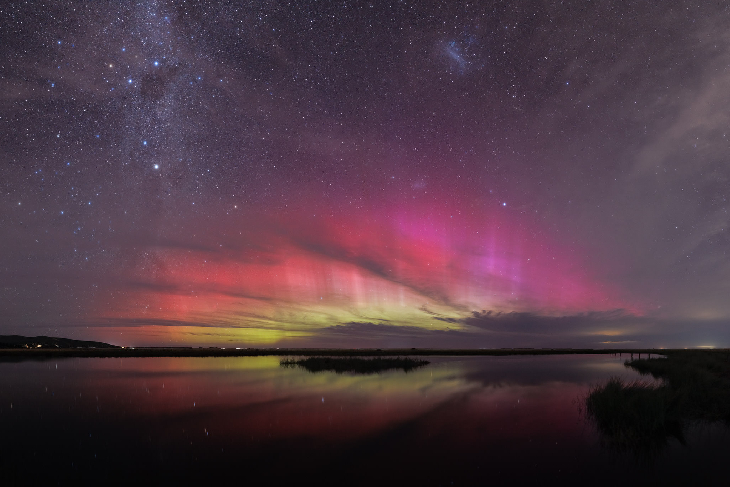
Aurora Australis
Taken by Mike White on March 24, 2023 @
Canterbury, New Zealand
Click photo for larger image

| |
Camera Used: Canon [Canon EOS R6]
Exposure Time: 6/1
Aperture: f/1.4
ISO: 3200
Date Taken: 2023:03:25 12:25:29
|
|
| More images
Details:
Aurora Australis, 24 March 2023
21:57 NZDT
Lake Ellesmere, Canterbury, NZ
What a night! Those who've been doing this a while know the frustration of multiple Kp alerts pinging on your phone - during the daytime. Multiple Kp 5s, 6s and even a 7 and 8! You charge your batteries, cross your fingers and hope there's something left for when the sun finally sets. The afternoon hours drag by and you're out in the field at sunset just waiting to see what lies beyond the horizon. Fortunately, last night wasn't a disappointment in the end (though many often are!) Cloud forecasts for Canterbury suggested a window of an hour or two after dark and though an increasing layer of high cirrus started to build, it wasn't thick enough to obscure the aurora - first a strong glow, visible even in late twilight, followed by periods of some beautifully tall rays extending up into the night sky. Activity faded, the cloud increased and around midnight it was time to call it a night.
This particular location is pretty close to the main road from Christchurch to Akaroa around the north-eastern shores of Lake Ellesmere - the amount of traffic was phenomenal - much of it seemed aimed for Birdlings Flat with plenty continuing along the Kaitorete Spit, most of these folks no doubt chasing the lights too. It was an enjoyable, mostly calm night, with the light northerly winds keeping temperatures in the mid-teens.
Here's a wide-field view, spanning more than 90° around the southern horizon, that highlights this is indeed the southern hemisphere version of the Aurora Australis - not to be confused with its northern cousin. Visible at left are the Southern Cross and "Pointers". The Large Magellanic Cloud can be seen high in the sky in the centre of the photo with the Small Magellanic Cloud tucked in behind the upper reaches of the pink aurora. 9th brightest star in our sky, Achernar, is to the right of the Magellanic Clouds. The high cloud acts as a diffuser causing the brighter stars to glow and reveal their individual colours.
The photo was shot as a multi-row panorama at 40mm in 3 rows of 8 frames. Each frame was exposed at f/1.4 for 6s at ISO 3200. Panorama stitching in PTGui and post-processing completed in PS.
Photographer's website:
https://mikewhite.co.nz
|
|
|