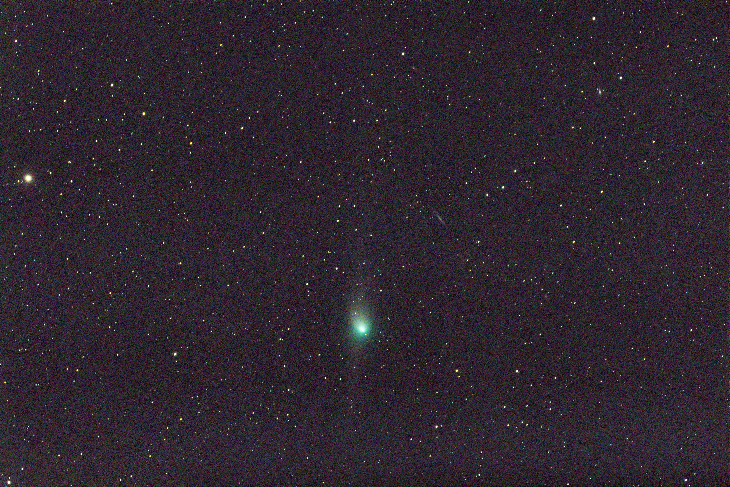
Comet C/2022 E3 (ZTF) with anti-tail and bonus galaxy
Taken by Jason Evans on January 23, 2023 @
Hampshire, United Kingdom
Click photo for larger image

| |
Camera Used: Canon EOS 70D
Exposure Time: Unavailable
Aperture: Unavailable
ISO: Unavailable
Date Taken: 2023:01:23 11:27:16
|
|
| More images
Details:
I am very pleased I was able to image the comet and show the anti-tail from my local park with Bortle 5 sky conditions (I think it's closer to 6) especially this morning the light pollution seemed even more pronounced, and the sky transparency was not great either.
It was -5° C when I was getting these images, where I am on the south coast of England, that's considered pretty cold! I had ice forming on my equipment but I was quite warm dressed with multiple layers and a electrically heated body warmer, face was cold though, wonder if you can get electrically headed face warmers!
After reading here about it probably being the best time to try and see the anti tail due to Earth passing through the orbital plane of the comet I had to give it a go and was glad I did, I have never observed an anti-tail before and this was my 20th comet (since spotted 2 more)
I even captured a faint galaxy (NGC 5907) I didn't even know about this galaxy so have been reading about it, apparently it's known as the Knife edge or Splinter galaxy and is 50 million light years away.
When I saw it as I was checking my light frames for aircraft or satellite trails I thought it might have ben a faint meteor or satellite trail and almost rejected it, but I noticed it in all my frames, so then wondered if it might be a digital artefact or even something to do with the temperature, perhaps an ice crystal on my lens was causing some kind of diffraction spike but why would it only affect one small spot.
I looked on the Spaceweather gallery and noticed it in another image and the poster was good enough to label what it was.
So that was a nice bonus I did not realise how faint object could be seen with just a camera lens, thought you needed huge telescopes for that!
I might be able to improve on this image as that stacking software I used is probably considered quite basic (Sequator) but it's free so you can't expect it to have all the advanced features of payware programmes but I actually like the simplicity of it, the final result looks quite good and doesn't require much further processing other than tweaking the light levels and colours a bit, which I do using the standard Windows photo editor.
I have Deep sky stacker as well but I'm not to impressed with the final results from that, probably something I am doing wrong.
I downloaded a free trial version of PixInSight which seems to be highly praised by more advanced photographers but from the tutorials I have watched it does seem a lot more complicated than I am used to and I find it a bit overwhelming, but I am going to try it out, nothing to loose really, if I cant figure it out I still have this image which is good enough by my standards!
This is a stack of 10 X 1 minute exposures I actually took 20 lights darks bias and flats but decided to just use 10 as the movement of the comet is noticeable with longer exposures.
Canon 70D with Sigma 150-600mm at 250mm
Skywatcher Star Adventurer for tracking.
Total exposure time 10 minutes
F/5.6
ISO 3200
Photographer's website:
No URL provided.
|
|
|


