| More images
Details:
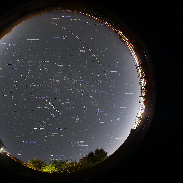
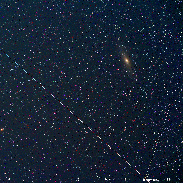
Bluewalker 3 (BW3) made a high-altitude pass (74°) tonight right at dark (photo #1), but I did not see it any brighter than a week ago when it was half as high--still between mags 3 and 4. It crossed the sky from SW to NE passing east of the zenith, disappearing into shadow shortly after passing between Mirach (beta And, the bright reddish star) and the Andromeda Galaxy (M31) (photo #2).
Andromeda was a major satellite crossroads. I numbered 13 of them in the 20-minute long photo but those are just the ones the camera recorded--the ones it didn't could probably double the count. When the mirrorless camera's electronic viewfinder (EVF) was gained up for night visibility in "boost mode" fainter satellites became visible as short trails (like a "dash" in Morse Code), and since its refresh rate would lag, the dashes would "skip" their way through the EVF, almost like they were writing Morse code messages among the stars. It was actually rather fascinating to watch, and scary, to see so many satellites skipping their way in every direction, considering how small field of view it was.
Binoculars picked up several more satellites in other parts of the sky, but two of them needed no viewing aids, either visual or electronic. They were mag 0 or brighter, one crossing W to E below Polaris, the other crossing SW to NE like BW3 but on a path west of the zenith. I don't know which ones they were (not planes--I checked with binoculars), but they were much closer to what I expected BW3 to be like.
Event data:
- Date: Nov 20, 2022 at end of dusk (= 6:51pm MST)
- BW3 pass duration: 6:49pm-6:57pm MST
- BW3 disappears into Earth's shadow at 6:56:31pm MST
- BW3 maximum altitude: 74°
Photo data:
#1: Panasonic GX8, Laowa 4mm fisheye lens, photo tripod
... 14 frames x (f/2.8, 30 sec, ISO 800) = 7 minutes, stacked in startrails.exe
#2: Panasonic G9, Olympus 75mm lens, SkyTracker Pro
... 20 subs x (f/2.8, 60 sec, ISO 1600) = 20 minutes, stacked in DeepSkyStacker
... N up W right. FOV = 13° x 10°.
Photographer's website:
No URL provided.
|