| More images
Details:
I have gotten way behind in submitting photos of the dawn's planetary procession. Even if it's old news now, maybe there's still a residual of passing interest.
The morning of July 24th was the date the planets and the Moon were most symmetrically arranged along the ecliptic, and the Moon could substitute for Earth in the lineup. I looked for a less domestic, more dramatic location for the planet panorama and found it at a place that overlooked canyons carved out by the Virgin River in SW Utah. (Zion Canyon in Zion NP is the most famous of these, but this spot was downstream from the park.)
There were families, lovers, and partiers at the overlook besides me. A lightning-laced thunderstorm moved through late evening. Overcast skies and high winds persisted afterwards until dawn. It wasn't until about 4am that I had the place to myself and the clouds broke apart enough to see the Moon for the first time. The receding storm clouds prevented ever capturing Mercury, and even Venus only escaped them at the start of nautical twilight.
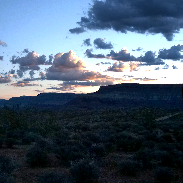
I stayed at the overlook until sunrise. At last all was calm, quiet, and serene. Cotton-candy cloud puffs covered the sky, lit bright white on the sunward side and dark gray on the shadow side. About 15 minutes before sunrise for about 5 minutes the whites turned brilliant pinkish red, then reverted back to white shortly before the Sun broached the horizon. The shifting patterns of shape, light, and color entranced me. It was one of the most surreal and beautiful sunrises I've ever seen.
The panorama that came out of this night was not the complete one with all the planets that I had intended, but at least the view is of nature, not of a bunch of houses.
Link to next planet in line to the west. (Mars)
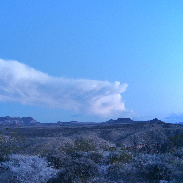
#1: Smoke plume from wildfires in Arizona being blown eastwards by high level winds shortly after sunset.
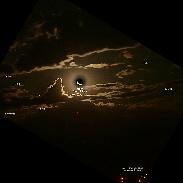
#2: The Moon doesn't visit any planet today. Pretend you could see Earth here.
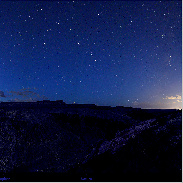
#3: Planet procession (without Mercury) over an unnamed canyon of the Virgin River.
#4: Puffy clouds just before sunrise. A timelapse would have captured far better the changes in light and color.
Photo data:
#1: Panasonic G9, pano, 20mm lens
#2: Panasonic G9, 35-100mm @80mm, f/2.8, 5 sec, ISO 1600
... celestial north is upper left, west upper right
#3: Panasonic GX8, pano/composite, 12mm
#4: Panasonic G9, pano, 20mm
Photographer's website:
No URL provided.
|