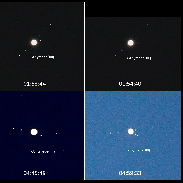
Ganymede (JIII) eclipse
Taken by Meiying Lee on July 8, 2022 @
Taipei, Taiwan
Click photo for larger image

| |
Camera Used: Unavailable Unavailable
Exposure Time: Unavailable
Aperture: Unavailable
ISO: Unavailable
Date Taken: Unavailable
|
|
| More images
Details:
Ganymede (JIII) eclipse.
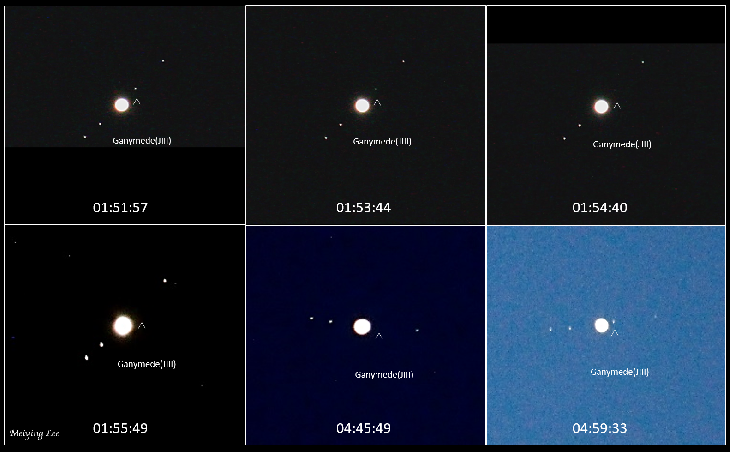
Today (July 8) around 1:50 a.m., Jupiter's brightest moon Ganymede (JIII) entered Jupiter's shadow to form a satellite eclipse. During this process, you will see that the four major satellites of Jupiter were originally paired on the left and right sides of Jupiter. At about 1:53, Ganymede, which is close to the right side of Jupiter, began to enter Jupiter's shadow. Although it looks like a small point, it is Ganymede can still be found gradually darkening in the long shot, and Ganymede almost completely disappears from view at 1:55! The video linked below shows Ganymede (JIII) entering Jupiter's shadow to begin the eclipse. We can see Ganymede (JIII) on the right side of Jupiter bright at first, then slowly dimming and then disappearing completely, very interesting. Video link: https://youtu.be/PF4uo9Js4vg. It wasn't until about 4:58 that Ganymede left Jupiter's shadow to end its three-hour eclipse. At this point, Ganymede appears to appear suddenly to the right of Jupiter, which is very interesting. Unfortunately, because the time of the software simulation was wrong, I didn't record Ganymede's sudden appearance from Jupiter's shadow. At 4:59, the four Galilean satellites around Jupiter all appeared again!
The photos in this group are the six image records of Ganymede's three-hour process from bright to dark, disappearing, and finally reappearing. In the last photo, the sun is about to rise and the sky has turned blue.
Photographer's website:
https://www.facebook.com/meiying.lee.98/
|
|
|