| More images
Details:
Last night Ceres occulted one star and made a close pass of another.
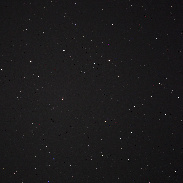
Photo #1 shows the full field of view (FOV) of the 300mm lens (3.3° x 2.5°). What looks like a double star at the center is the asteroid Ceres (upper) at mag 7.2 and the star HD 285481 (lower) at mag 10.0 that it's passing by.
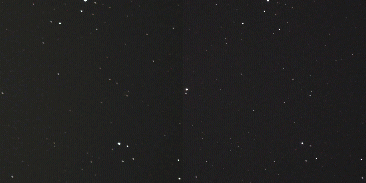
Photo #2 is a close-up animation of Ceres' movement over ~3.5 hours. The asteroid, 4 days past opposition in retrograde motion, is moving from left to right.
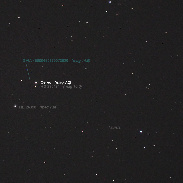
Photo #3 labels things. The pinpointed star is GAIA 45909459479073920 (mag 14.9). This was the one occulted by Ceres at 9:29pm MST for the Salt Lake City (Utah) area. I only discovered the event earlier that afternoon using Sky Safari Pro 6 and doubt it could be observed even in a big telescope since the objects had such discrepant brightnesses. For St. George 300 miles to the south, the star passed just under (south of) Ceres, well within its glare and well outside my equipment's ability to resolve them.
#1: General FOV just W of the Hyades in Taurus.
#2: Animated GIF of Ceres' movement over ~3.5 hours.
#3: Labelled close-up pinpointing the star that was eclipsed.
Photo data:
Panasonic GX8, Lumix 100-300mm lens @ 300mm, iOptron SkyTracker Pro.
Timelapse of 120 frames x (f/5.6, 60 sec, ISO 1600) at a cadence = 3 min;
first and last best frames in the animated GIF (seeing improved during the night)*.
N up, W right; wide-field FOV = 3.3° x 2.5°.
Date: Nov 30 - Dec 1, 2021; 9:15pm-12:45am MST.
* If you compute it, 120 frames 3 minutes apart should span 6 hours, not 3.5, but the tracker's battery gave out earlier than expected. The camera's battery, on the other hand, almost made it to the end--not bad for a mirrorless camera. It was when switching camera batteries that I discovered tracking had stopped sometime earlier. Reviewing the timelapse showed I did get past the halfway point, at least.
Photographer's website:
No URL provided.
|