| More images
Details:
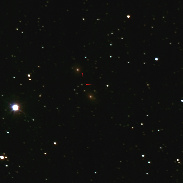
This type-Ia supernova (inside the red tick marks), discovered back in late August, is still near its peak brightness 2 months later; the latest brightness estimate I could find was mag 14.5 on Sep 21. It's always fascinating to realize that what one is seeing from over 150,000,000 light years away is one single star in its death throes, yet there's no obvious visual difference to the placid, normal stars in our own Milky Way next to it on the sky. I was particularly intrigued by its peculiar position midway in the gap between the 2 spiral galaxies NGC 6500 (the lower one) and NGC 6501. It appears to be a galaxy diameter away from either of them, deep in intergalactic space. It's so isolated from them it doesn't seem to belong to either galaxy: a member of an invisible intergalactic community of rogue stars and planets--and who knows, maybe life?--forever lost to their home galaxies. At least, it's easy to imagine it so.
Photo data:
Sep 29, 2021, 10pm MDT (= Sep 30, 2021, 4:00 UT)
Panasonic G9, 5.5" Celestron Comet Catcher (500mm FL), iOptron GEM45G (unguided)
60 x (f/3.64, 1 min, ISO 1600) = 1 hour
N up, W right; 2° x 1.5° FOV cropped to 20' x 15'
Photographer's website:
No URL provided.
|