| More images
Details:
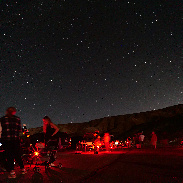
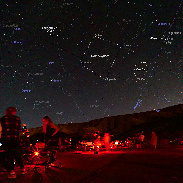
As part of the Southwest Astronomy Festival sponsored by the National Park Service, a public star party was held at Gunlock State Park northwest of St. George 2 weekends ago. This photo--actually a vertical panorama of 2 photos--was taken towards the end of the evening as the quarter Moon was nearing setting, the crowds were thinning out, and the autumn constellations had begun their ascent. Labelled and unlabelled versions.
The photo shows 4 prominent naked-eye autumnal asterisms. Here is one interesting fact involving each of them.
#1: Great Square of Pegasus. Fall's most prominent asterism.
The east side (lower side in the photo) of the square (Alpheratz and Algenib) runs close to and parallel to the zero-hour line of right ascension. The precession of the equinoxes (the 26,000-year long cycle of the wobbling of the earth's axis) is slowly shifting the line to the west. 250 years ago they were on top of each other; live long enough--to the year 3100--and the zero-hour line will align with the other side of the square (Scheat and Markab).
#2: Water Jar. A tight "Y"-shaped group of four 4th-magnitude stars in Aquarius.
Precession affects declination too. The declination line that is the celestial equator runs just below the Pisces Circlet and smack dab through the center of the Water Jar. In autumn skies the equator is slowly tilting downwards (while in spring skies it tilts upward). So despite not moving an inch, Zeta Aquarii (ζ Aqr, the "Y"'s central star) shifted from being in the sky's southern hemisphere to its northern one a few years back in 2003. The star Eta (η Aqr) will follow suit around this time next year.
#3: Circlet of Pisces. Represents the western of 2 fishes tied together with a cord.
It contains the 2nd-brightest carbon star in the sky: TX Psc (springtime's U Hydrae just edges it out). As a youthful carbon star it's more orange than red, but in binoculars its color still stands out. It varies from mag. 4.9-5.5. Also, the First Point of Aries--where the zero-hour line, celestial equator, and ecliptic all intersect, marking the Sun's position in the sky on the first day of spring--lies about 5° to the southeast.
#4: Frederick's Glory. Marks the rock Andromeda is chained to.
This seems to be a favored spot to break off into its own constellation to commemorate royalty. In the 1800's it was to honor Frederick the Great of Prussia and went under the names Friderichs Ehre, Honores Friderici, or Gloria Frederici. In the 1700's it honored Louis XIV of France under the name Sceptrum. In the 1900's when the constellations were standardized Freddy and Louie lost theirs, but at least Freddy managed to keep his name on the asterism, probably because "Gloria" sounds glorious while "Sceptrum" sounds rather cold and clinical.
Photo data:
Panasonic G9, Laowa 10mm lens, photo tripod
2 frames x (f/3.2, 10 sec, ISO 3200) joined into a vertical panorama
Photographer's website:
No URL provided.
|