Light Pollution Spectrum
Taken by Vishal Sharma on January 21, 2021 @
Greater Noida Extension, Uttar Pradesh, India
Click photo for larger image

| |
Camera Used: Unavailable Unavailable
Exposure Time: Unavailable
Aperture: Unavailable
ISO: Unavailable
Date Taken: Unavailable
|
|
| More images
Details:
We have certainly lost our beautiful skies. Here is the proof in my Light Pollution Spectral Image.
Not just because I am an avid amateur astronomer that I care about the impact of Light Pollution, but because it’s way more devastating for us and other species who inhabit our planet. Birds, insects are far more susceptible to the evils of sky glow.
Night lightening produces so much of sky glow which creates havoc on our biological systems as well those of migratory birds, nocturnal insects & animals.
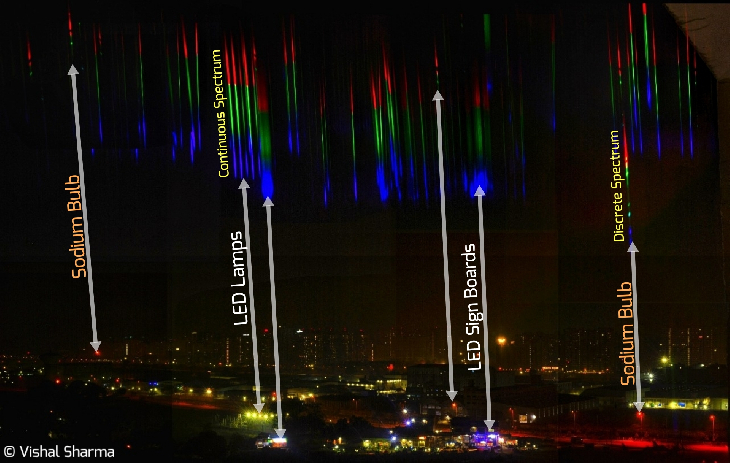
The image taken by me gives the sad state of affairs of living in Urban cities, the spectrum of light pollution is visible and some isn’t, the fact remains that we are wasting energy as well as putting our ecological system at harm’s way, we need to pay heed to so many researches available and form a global policy to eliminate this ugly problem threatening so many species of Earth.
Typically one can observe two types of spectra i.e. Continuous and Discrete. In a continuous spectrum, the light is composed of a wide, continuous range of colors (or white light). With discrete spectra, one sees only series of bright or dark lines at very distinct and sharply-defined colors. In my Light Pollution Spectral image one can easily identify the highly light polluted area shows continuous spectra which is mostly located at the mid of the image because it is a commercial as well as residential area equipped with white light LED street light lamps. LED Light is one of the best examples of continuous spectrum, whereas you can see some discrete spectra with bright colors & black absorption lines at right & left side of the image, those are from Sodium bulb street lights. I have used 50mm lens to take single shot with 2 seconds of exposure. You can see some highly contrast vertical strips in my image this is because of image mosaic or stitching, to make a single panorama. You can those highly contrast & lower contrast areas in this image which clearly differentiate the areas of heavy light pollution & lower light pollution areas in my vicinity. By this analysis, now i know that at which part of the sky i can do Astrophotography & at which part not. Thanks to the Spectrum analysis that makes it easy for me to identify the areas of heavy LED Light lamps LP, without even physically going to that area.
The traditional orange-hue, low-pressure sodium-vapor street lamp emits light very close to 589nm on the visible spectrum, with a color temperature around 2700K—like household incandescent bulbs. Some lamps use mercury-vapor bulbs that have wavelengths between 400-600nm and a color temperature around 6800K. Many sodium and mercury-vapor lamps are being replaced with energy-efficient LED lights that transmit at a huge range of wavelengths (in outdoor lighting, it is usually a shorter wavelength) and have a color temperature that varies from 2200K-6000K. While good for your local electricity department' electrical bill, LED lights increase light pollution due to their increased brightness over traditional lamps, and their whiter light has potential health ramifications.
Around the house, we create our own light pollution. When I do Astrophotography in my balcony, not only do I have to contend with the street lamps nearby and the commercial market in my west, but I know that my kitchen & room lights will wash out the night sky if I fail to turn them off before heading outside.
Humankind's view of the cosmos is in a steady decline. We have lost our Milky Way & Stars in urban skies due to the wastage of light photons from artificial sources. Dark skies are a thing of the past for most of us. So we need to save our Light energy to protect other species & to prevent our night sky for the next generation.
Date of Spectral image: 21-01-2021
Location: Greater Noida Extension, UP, India
Nikon D7100 @ 50mm
F-ratio: f/1.8
ISO- 800
Deffraction Grating
Exposure: 2 seconds of single shots.
Processed in Photoshop & Snapseed.
Photographer's website:
https://vishalastronomyforum.wordpress.com/
|
|
|