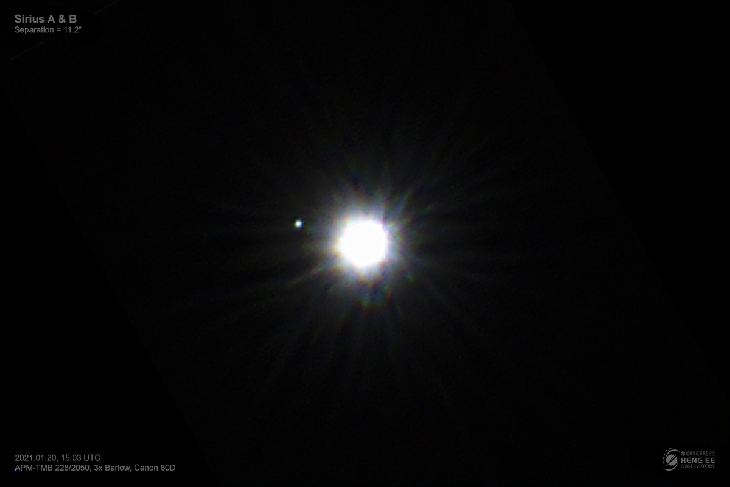
Sirius A and B
Taken by Michael Teoh on January 20, 2021 @
Heng Ee Observatory, Penang, Malaysia.
Click photo for larger image

| |
Camera Used: Unavailable Unavailable
Exposure Time: Unavailable
Aperture: Unavailable
ISO: Unavailable
Date Taken: 2021:01:22 07:10:41
|
|
| More images
Details:
First attempt at imaging Sirius B. Sirius, the brightest star in the night sky (mag -1.46) is actually a binary star, consisting of the prominent Sirius A (mag -1.47) and a faint companion white dwarf (mag 8.44).
The two orbit each other with a period of 50 years. Due to the eccentric orbit, the distance between the two varies between 8.2 and 31.5 AU, resulting in an apparent angular separation between 3 and 11 arcseconds.
The previous periastron (closest physical distance between the two) occurred in 1994, while the apoastron (furthest physical distance between the two) occurred in 2019. From the Earth's vantage point, the greatest observational separation will occur in 2023, with an angular separation of 11.333 arcseconds.
APM-TMB 228/2050, Televue 3x Barlow, Canon 60D, 30 x 1 sec exposure stacked and cropped.
Photographer's website:
https://www.facebook.com/MichaelTadashi
|
|
|