| More images
Details:
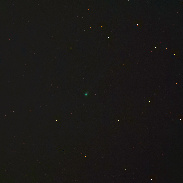
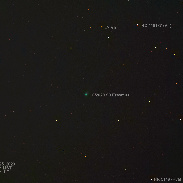
Finding the comet was difficult. I drove to a nearby park and set up my tracker outfit on a windy, freezing morning and then took a series of test shots to locate the barren area of sky where the comet would rise above the low mountains in this direction. Once spotted and centered in a test shot I shot a 20-minute sequence. I didn't lose a single sub due to wind--surprisingly for the overloaded tracker--but the first few subs were dimmed by ground haze and left out of the stack.
Once the comet rose high enough I began to see the tail dimly on the camera's monitor (the back LCD screen). On the other hand, I don't have the processing prowess of others here to make the comet's tail stand out dramatically in the final image. But if you look closely it extends approximately 2/3 of the way to the upper right edges of the frame, which works out to being a bit over 1° in length. Visually, I never saw the comet in my 8x56 binoculars.
If you want to image the comet in a dark sky you'll need to act quickly. It's dropping in altitude by 1° a day towards when it rises with the start of astronomical twilight, which occurs next Friday (Dec 4). I shot this sequence between altitudes 3°-7.5°, ending just before the start of astronomical twilight.
Photo data:
Panasonic G9, iOptron SkyTracker Pro, William Optics Redcat 51 (250mm FL).
34 x (f/4.9, 30 sec, ISO 1600) = 17 min. Processing in DSS and PSP X2.
Photographer's website:
No URL provided.
|