| More images
Details:
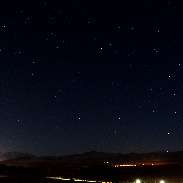
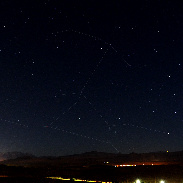
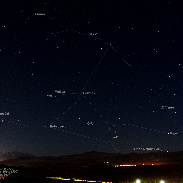
Proof that Orion is a Zodiac constellation (at least occasionally) with Venus inside Orion's club. Labeled and unlabeled versions.
Some of the official boundaries for non-Zodiac constellations come extremely close to the ecliptic, such that sometimes the planets and Moon pass through them anyway. For the most part this business is invisible since you can't see these boundary lines in the sky and is just an interesting curiosity. However, passing through a constellation figure is something else since you can see the stars that make up the figure, and Orion's club is a fairly well-known asterism consisting of the stars chi1, chi2, xi, and nu Orionis. People "connect the (star) dots" in different ways, but most versions of Orion's shape I've seen include the club stars in some fashion.
As for Venus itself, during its recent passage through the Pleiades it was mentioned on this website that, due to resonances between Venus and Earth, it will appear again at the same spot on the same day at the same time 8 years hence. Apparently that applies to other points in its orbit too. Using a planetarium program to look ahead 20 years, the next 2 times Venus will be in the club occur on Aug 7, 2028 and Aug 7, 2036. It takes 2 days for it to traverse the club moving W-E.
During the next 20 years I found no other occurrences where a planet passes through Orion's club except one. Jupiter and Saturn are just too far away to stray much from the ecliptic. Mars never dips S of the ecliptic into Orion although it often swings considerably N of it next door in Gemini.
Mercury passes through the club twice: Jun 23-26, 2027 and Jul 11-13, 2027. The first time it's moving E-W (retrograde) but it's 6* from the sun and in fact rises with it--I didn't count that. A few days later it reverses direction and starts moving W-E again, but meanwhile the Sun has pulled away to >20*.
This should be observable, but it'll be dawn then and probably require binoculars.
As for the Moon, it moves above and below the ecliptic on the saros cycle of 18 years. However, we are just past the time it can be in Orion's club. It won't be that far S again until Mar 2031.
Photo data: Panasonic FZ300 superzoom camera at 2x zoom (50mm EFL),
camera mounted on an iOptron SkyTracker Pro.
1 exposure: f/2.8, 25 sec, ISO 800. Processed in PSP.
Photographer's website:
No URL provided.
|