| More images
Details:
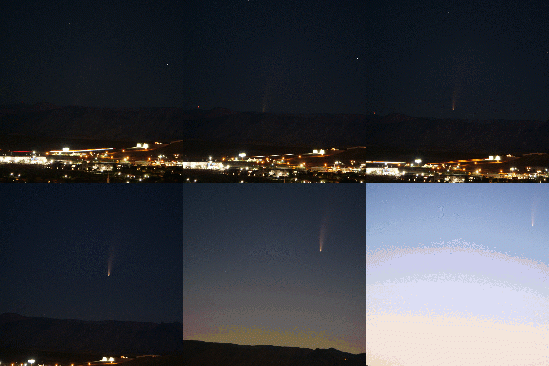
Time lapse of comet C/2020 F3 NEOWISE rising tail-first on July 8, 2020 between 4:32-5:21am MDT. Mountains blocked the first 2° of the horizon, so the comet was that high when its nucleus first appeared and 8° high by the end.
In 7x35 and 15x50IS binoculars the comet's tail was 2.5-3° long and averted vision roughly doubled that. Its bifurcation was also visible although, curiously, best seen when the sky background wasn't completely dark but partway into nautical twilight. No feathering was noted. Once into nautical twilight the tail seemed to shrink 1° every 10-15 minutes as its faint glow dissolved into the expanse of brightening blue.
Despite the brilliance of the nucleus and the length of the tail, I still didn't definitively see the comet naked-eye, although I may have glimpsed it briefly with averted vision near the beginning of nautical twilight where its higher altitude vs. increasing dawn balanced each other out.
Astro data-----
Date: July 8, 2020 (before sunrise).
Moon: fat waning gibbous just past meridian.
Comet rises above true horizon: 4:20am MDT.
Astronomical twilight begins: 4:31am.
Timelapse begins: 4:32am (comet still below local horizon).
Nucleus appears: 4:37am (comet 2° high).
Nautical twilight begins: 5:13am (comet <7° high).
Timelapse ends: 5:21am (comet 8° high).
Civil twilight begins: 5:51am (comet 12° high).
Sunrise: 6:22am (comet >17° high).
Photo data-----
Panasonic G9, Lumix 100-300mm lens.
iOptron SkyTracker Pro running at half sidereal rate.
Each frame: @100mm, f/4, 10 sec, ISO 400, 5 sec interval.
196 frames taken; 32 used in the animated GIF.
Photographer's website:
No URL provided.
|