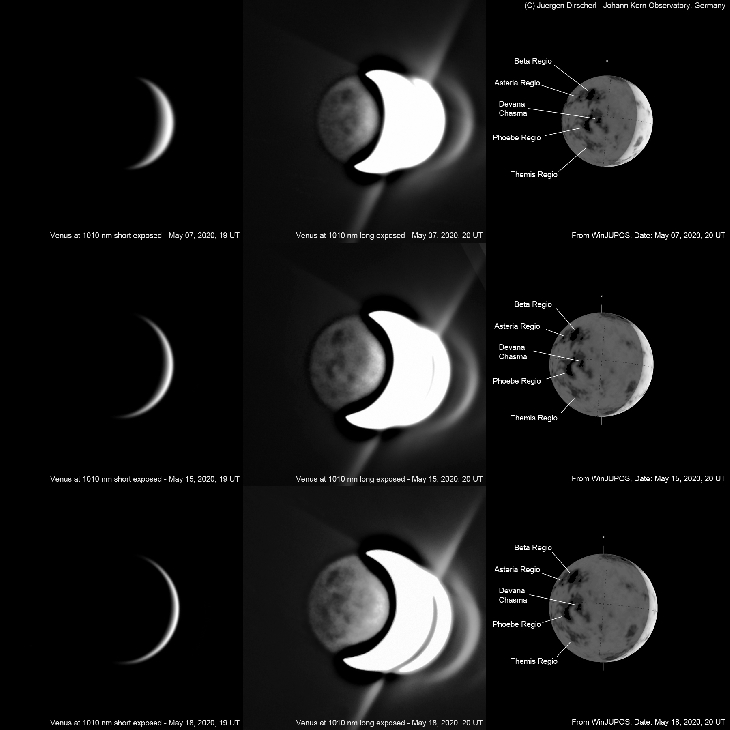
Venus surface features observed in infrared (1010 nm)
Taken by Juergen Dirscherl on May 18, 2020 @
Wertheim, Germany
Click photo for larger image

| |
Camera Used: Unavailable Unavailable
Exposure Time: Unavailable
Aperture: Unavailable
ISO: Unavailable
Date Taken: 2020:05:30 21:01:56
|
|
| More images
Details:
Normally the surface of Venus is completely hidden by thick clouds of sulphuric acid. The surface pressure is around 92 bar (1334 psi) and its temperature at 460 °C (860 °F). At this high temperature the surface glows and emitts infrared radiation. In the nineties it was found that there is a small spectral window in the infrared region around 1010 nm were radiation may pass the thick atmosphere and the clouds. So we speak of glowing light from the Venus itself and not reflected sunlight. To see this dimm glow it is necessary to observe the night side of Venus with a narrowband filter at 1010 nm. There are only rare occasions a few weeks before and after lower conjunction when the night side of Venus is sufficiently well visible.
The upper row of the picture shows images taken on May 7, 2020. On the left side there is a "normal" image of Venus taken with short exposure time. So the bright sunlit crescent of Venus is visible.
The middle image shows Venus with heavily overexposure of the crescent - the glow of Venus is visible on the dark side. The dark structures therein are highlands of Venus. These are cooler than the lowlands and emit less radiation. The right image shows a Venus surface simulation (with WinJUPOS) with some annotations - verifing the dark spots in the middle image as true surface structures of Venus.
The middle row and lower row of the picture show analogeous images taken on May 15 and May 18. The dark structures are well reproduced and rotate slowly in the right direction.
Photographer's website:
No URL provided.
|
|
|