Birt Domes and Region
Taken by Howard Eskildsen on December 5, 2019 @
Ocala, Florida, USA
Click photo for larger image

| |
Camera Used: Unavailable Unavailable
Exposure Time: Unavailable
Aperture: Unavailable
ISO: Unavailable
Date Taken: 2020:01:03 18:56:49
|
|
| More images
Details:
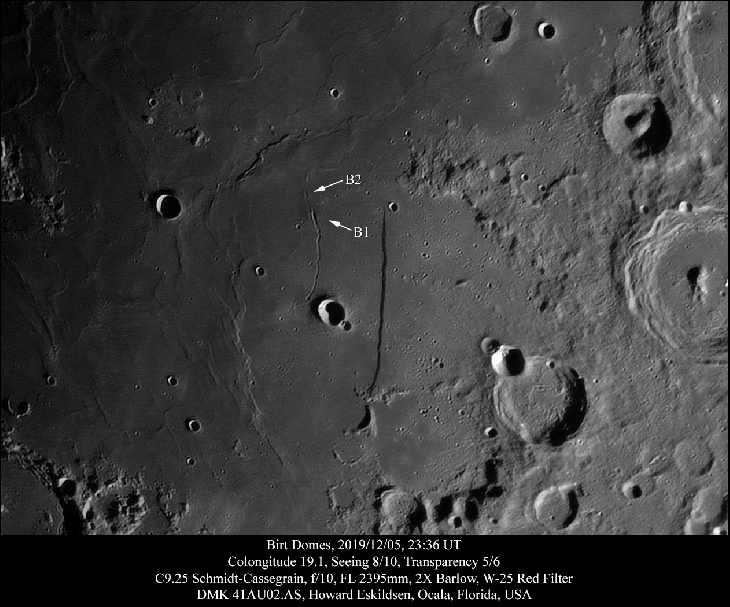
Behold the Sword of Huygens cutting vertically across the central image with the “handle” at the lower end. Rupes Recta, which forms the blade is a normal fault that is 110 km long and 300 meters high per the Virtual Moon Atlas (VMA). To its left, the craters Birt (17km diameter) and Birt A (6.8 km) overlap, and both show asymmetrical slumping on their interiors.
To the upper left of Birt, Rima Birt courses upward about 55 km per LROC QuickMap measurements and terminates at the dome B1 noted on the image. Near its termination on the left margin of B1, a rille continues upward for another 16 km to B2. The rilles run radial to the Imbrium Basin. Domes B1 and B2 are "bisected domes" and imply a volcanic origin for the rilles. Per http://rupesrectadomes.blogspot.com/ Birt 1 is 16 km wide, 170 meters high and has a slope of 1.2 degrees. Birt 2 is 7.8 km wide, 70 km high, with a slope of 1.0 degrees.
Farther to the left, the 15 km Nicollet rests at the intersection of several wrinkle ridges or "dorsa." These were caused by compression of the terrain, probably sagging under the weight of the mare basalt as it cooled. Just below Nicollet the dorsa form an irregular arc reminiscent of Lamont in Mare Tranquillitatis.
On the lower right of the image a trio of craters resembles an expansion of the Birt and Birt A theme. The 58 km Thebit has its northwest rim pocked by the margin of 20km Thebit A, which is in turn indented by 12 km Thebit L. The latter two craters also show asymmetrical interior slumping, likely from their common wall and leaving the question how they might have appeared without the slumping.
Finally, part of 97 km Arzachel is visible on the right margin and above it the strange looking, 40 km Alpetragius. It has a central peak about 15 km wide at the base per my measurement using QuickMap. This is huge for a central peak and brings to mind the old quote: "That's no banana, that's my nose..." (If you're under 50, or just don't know, Google "Jimmy Durante”) The crater interior is covered in ejecta which may contribute to its strange central peak.
I just love this part of the Moon.
Photographer's website:
No URL provided.
|
|
|