| More images
Details:
Around midnight EST on the evening of November 21-22, I observed a small but distinct increase in meteor activity via reflections of Canadian analog television signals. This was right around the time frame of 11:50pm EST that was announced on spaceweather.com as being the predicted time for a potential Monocerotid outburst.
Clouds prevented visual observations, but from my location in central Virginia I can receive meteor scatter reflections from three different Canadian TV stations that are all broadcasting on analog channel 3. These stations are located in Timmons, Ontario; Florenceville, New Brunswick; and Port Hawkesbury, Nova Scotia. Their transmissions yield meteor echo traces separated by a few dozen Hertz, with echoes from the closest and strongest station in Ontario showing up at a slightly lower frequency, the most distant and weakest station in Nova Scotia higher, and the New Brunswick station in between.
The midpoints between these transmitters and my location (the zones where ionized meteor trails will steer distant RF transmissions my way) lie above and along an East-West path that runs from near Provincetown, MA, across New York State, and on toward Hamilton, ON.
All of the targeted TV stations have recently lowered their output power, and since about November 15, 2019, the station in Nova Scotia has been transmitting a sweep frequency signal instead of the normal broadcast signal, probably indicating that it is soon going off-air entirely as Canada’s last remaining analog TV stations are being shut down.
Reflections from the Nova Scotia station have become few and far between recently, but three echoes from it appeared within minutes of each other a little before and after midnight EST. Since this station is the weakest, most distant, and most north-easterly for me to receive, these three consecutive echoes seem to offer supporting confirmation of the predicted Monocerotid shower time and position.
Each of the accompanying screenshots show approx. 3 hours of activity observed near the analog channel 3+ video carrier frequency of 61.260 MHz. The monitoring equipment is an RTL-SDR V3 dongle running HDSDR in CW mode, with a home-made 5 element yagi antenna and Channel Master Model 7777 preamp.
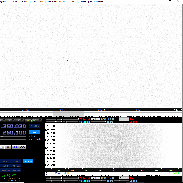
The first image is from the late afternoon/early evening period and shows the normal scarcity of activity from about 4pm through 7pm. (Note: The upper display shows raw RF activity, the lower right display shows resultant audio beat frequency output over a 30 second period.)
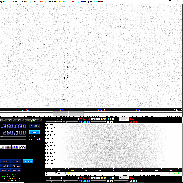
The second image shows meteor reflections beginning to pick up around 11:20 pm and remaining consistently enhanced through about 12:20 am. Reflections from the Nova Scotia station are distinctive because of the extended horizontal lines they produce, thanks to the unusual 'sweep frequency' transmission mentioned above. No echoes from the Nova Scotia station had been observed during the previous 7+ hours, but three of the characteristic sweep traces appeared between about 11:55 pm and 12:08 am. Note also the especially strong and persistent echo that came from the Ontario station at about 12:10 am.
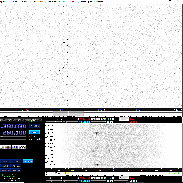
The third image shows that reflections from the Ontario and New Brunswick stations continued at a consistent level throughout the night and into early morning hours, while only one more and relatively weaker trace from Nova Scotia was observed, this one just after 5:00 am EST.
All in all, while this event may not have been the major meteor outburst many were hoping for, and acknowledging the fact that my amateur observing station has its limitations when it comes to data analysis, it does seem that something out of the ordinary did occur at almost precisely the predicted time of the Monocerotid shower.
Photographer's website:
No URL provided.
|