Lunar Alps & Alternate Method High Res Lunar Imaging
Taken by Ralf Vandebergh on April 16, 2019 @
the Netherlands
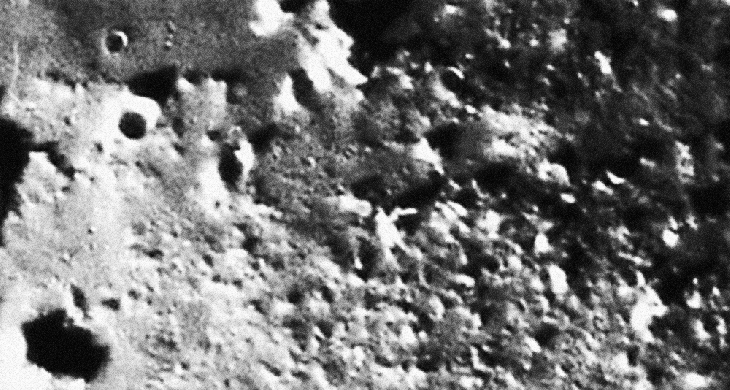
Click photo for larger image

| |
Camera Used: Unavailable Unavailable
Exposure Time: Unavailable
Aperture: Unavailable
ISO: Unavailable
Date Taken: Unavailable
|
|
| More images
Details:
CLICK ON THE IMAGE FOR FULL RESOLUTION.
This high resolution image of an area in the Lunar Alps was taken with an alternate technique then the commonly used image stacking method. Note that the lunar surface is resolved to very small craters at the edge of the resolution (as marked in the yellow box). This is especially nicely visible if you click on the image to get the full resolution and watch this from some distance on your screen. The method that I used is very different then the usual image stacking method that is used nowadays in high resolution planetary and lunar imaging. I already used the method for years in manually tracked - high resolution ISS and satellite imaging were it in general is not possible to obtain enough frames for a good average stack. Often, in this case, single frames are used instead. Blurring of an average stack due to stacking multiple frames due to differences between the frames caused by seeing disturbances are absent with the result that on quality selected frames can contain high original sharpness and high resolution but with a low signal-to-noise ratio. Demonstrated is that the signal/noise ratio can be increased with a large amount if the image is processed very carefully and if it is ensured that the image sharpening remains below the noise limit in the entire procedure.
Image was taken with a 10 inch (25cm) F/4,8 Newtonian reflector and ALccd 5L-11 mono CMOS camera in average seeing conditions.
Photographer's website:
http://www.ralfvandebergh-astrophotography.simpsite.nl/home
|
|
|