Daylight Planets
Taken by Tom Harradine on August 13, 2016 @
Brisbane, Australia
Click photo for larger image

| |
Camera Used: Unavailable Unavailable
Exposure Time: Unavailable
Aperture: Unavailable
ISO: Unavailable
Date Taken: 2016:08:14 16:43:55
|
|
| More images
Details:
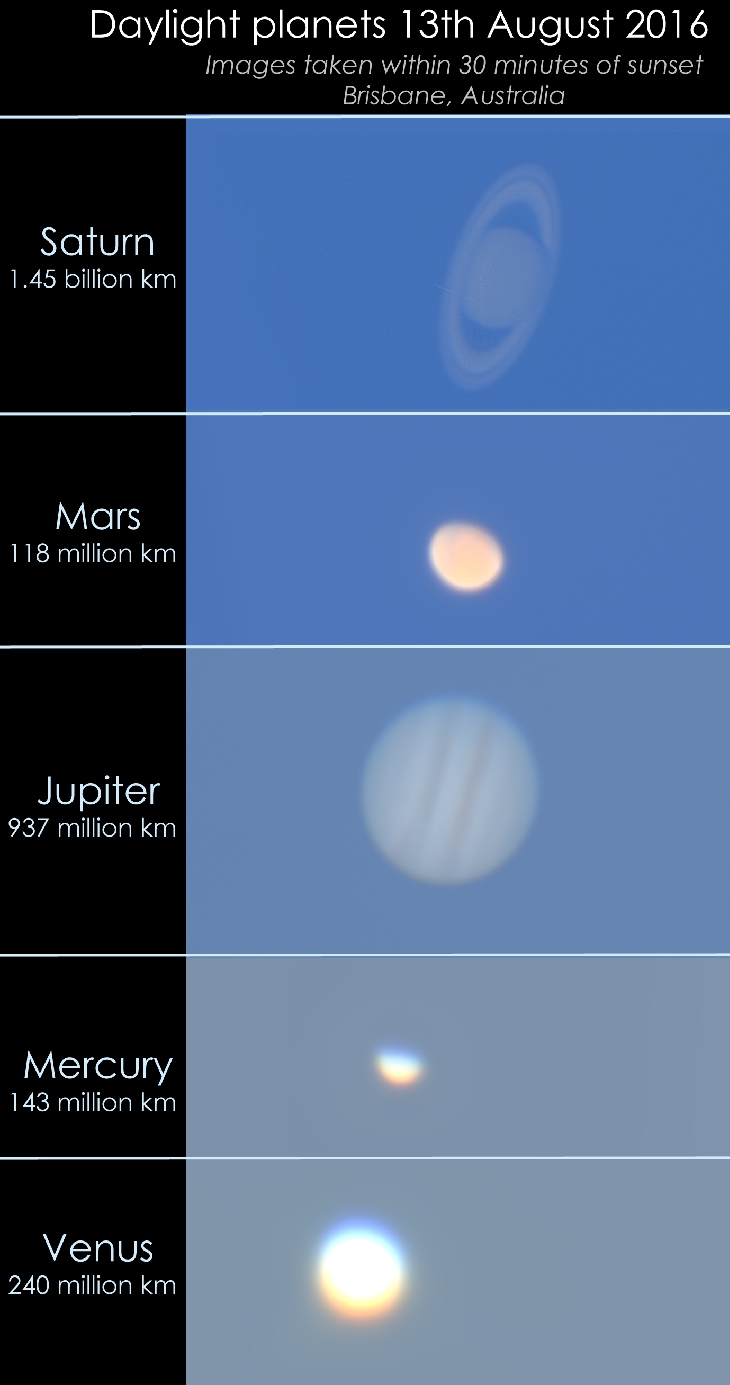
A clear afternoon in Brisbane yesterday allowed for an attempt to capture five major planets against a blue sky. Each planet is shown at the same magnification. Venus, Mercury, and Jupiter are closer to both the horizon and the setting Sun so the sky has less colour and is brighter. Higher up in the sky Mars and Saturn are seen behind a deeper blue and darker sky. The planets become visible to the naked eye as the sky becomes shrouded in the Earth's shadow. Venus and Mercury appear so bright because they are close to the Sun and receive more light than we do on Earth. Venus appears so much brighter than Mercury (even though it is further from the Sun) because its cloud-tops reflect about 75% of the sunlight received where Mercury's dark soil reflects only about 6%. Mars is the next furthest from the Sun, then Jupiter then Saturn. This means these planets have a increasingly lower surface brightness.
You may also notice that Venus and Mercury have a blue and red fringe around them. This is not caused by camera/telescope optics but is due to the fact that they were imaged lower in the sky. At such shallow angles, the refraction of white light entering our atmosphere, into different colours, is more pronounced.
Canon EOS 70D in video crop mode, Televue 5x Powermate, Sky-Watcher 14" Dobsonian telescope.
Photographer's website:
http://https://www.facebook.com/tom.harradine.12
|
|
|