Perseid Meteor Radiant
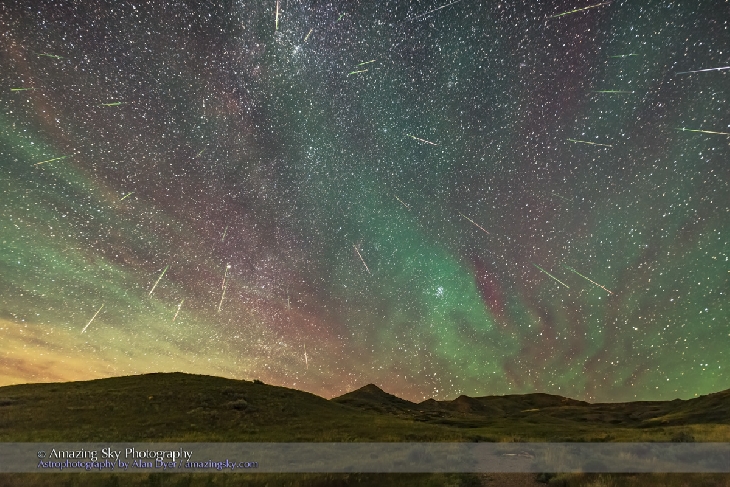
Taken by Alan Dyer on August 11, 2016 @
Grasslands Natl Park, SK
Click photo for larger image

| |
Camera Used: NIKON CORPORATION NIKON D750
Exposure Time: 30/1
Aperture: f/2.0
ISO: 5000
Date Taken: 2016:08:13 18:09:03
|
|
| More images
Details:
A composite of the Perseid meteor shower, on the peak night, Aug 11/12, 2016, looking northeast to the radiant point in Perseus left of centre, with the Pleiades and Hyades clusters in Taurus rising. There are 33 meteors here. Note the fairly consistent green to red tint of each meteor streak. A couple of streaks look more white and might be flaring satellites though their trajectory matches where a Perseid should be.
The sky is also filled with bands of red and green airglow which in the time-lapse sequence are moving from south to north, right to left here. The airglow was bright enough that it was visible to the unaided eye as grey bands in the sky, especially the loudaround the Pleiades.
The reddish/orange patches at upper left are the remains of a long-lived moketrail from an expoding meteor earlier in the evening, which I of course missed capturing.
This was taken from the Dark Sky Preserve of Grasslands National Park, Saskatchewan, from the trailhead parking lot at the end of the 70 Mile Butte Road.
This is a stack of 31 frames containing meteors (two frames had 2 meteors), shot from 1:13 am to 2:08 a.m. CST, so over 55 minutes. So considering the camera would have missed the fainter meteors and is seeing only one section of the sky, 33 meteors over 55 minutes is a great count, translating to perhaps ~ 100 to 150 over the whole sky? This is from latitude 49° N.
The camera was not tracking the sky but was on a fixed tripod. I choose one frame with the best visibility of the airglow as the base layer. For every other meteor layer, I used Free Transform to rotate each frame around a point far off frame at upper left, close to where the celestial pole would be and then nudged each frame to bring the stars into close alignment with the base layer, especially near the meteor being layered in. This placed each meteor in its correct position in the sky in relation to the stars, essential for showing the effect of the radiant point accurately.
Photographer's website:
http://www.amazingsky.net
|
|
|