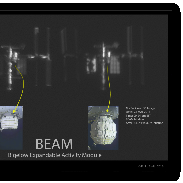
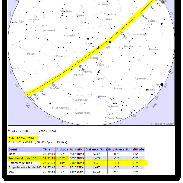
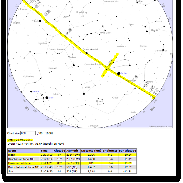
BEAM Habitat Module Docked To ISS
Taken by Philip Smith on May 28, 2016 @ Manorville, NY, USA
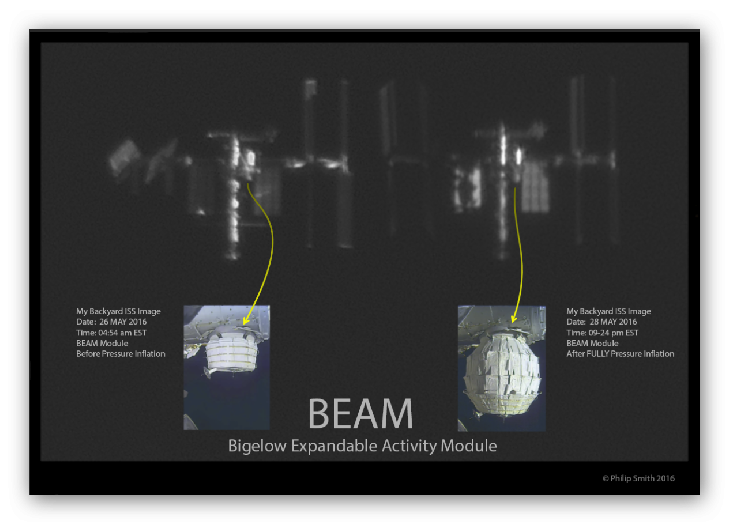
Click photo for larger image
  Camera Used: Unavailable Unavailable
Exposure Time: Unavailable
Aperture: Unavailable
ISO: Unavailable
Date Taken: Unavailable
 
More images
Details:
I think I am the 1st Amateur Astronomer from his own backyard to image BEAM Module Habitat docked to The International Space Station, Before and After BEAM was FULLY Pressure Inflated. (BEAM) is The Bigelow Expandable Activity Module is seen fully inflated on the International Space Station on my image dated May 28, 2016 after being successfully expanded to its full size on May 28, 2016. The Bigelow Aerospace-built BEAM is a prototype space habitat for future space stations, moon colonies and moon bases. So now I think I am now part of that history. I hope you like my images. Kind Regards to ALL!
Photographer's website:
No URL provided.
Comments
  You must be logged in to comment.  
Congratulations !
Stunning images !
Posted by sweiller 2016-05-30 15:35:33
Great work.... and really you are part of history... No doubt...
I suggest you use your skills on photographing satellites to work for gravitational changes of Earth using changes in orbits of satellites.
Posted by mbnaqvi78 2016-05-31 03:04:46
well done! What is the telescope used?
Posted by wsouza 2016-05-31 12:50:30
Hello, member wsouzaI. I used an Edge HD 14 with a 1.6X barlow, and orange filter on a lumenera Skynyx 2.0m CCD camera.
Posted by Philip Smith 2016-05-31 18:20:40
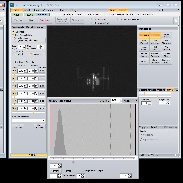
This is to answer what was the camera setting. I am sharing files for 28 May 2016. Hope this helps.

Capture start time = Saturday, 28 May 2016 21:21:56 / UTC -4 Hours
Capture duration = 200.95 Sec

Captured frames = 13270
Dropped frames = 8
Capture frame speed = 66 Fps

Camera = Lumenera SKYnyx2-0M
pixel size = 7.40 x 7.40 µm²

Image format = MONO - 12 Bit
Capture format = Ser / Format16bppGrayScale
Image type = Light frame
RoI size = 640x480
Frame rate = 66.6 Fps
Exposure = 0.94 ms
Gain = 4.67
Gamma = 1.00
Contrast = 1.00
Brightness = 1.0
Image flipping = None
Posted by Philip Smith 2016-06-01 06:45:10
This is to answer how I track the ISS: I start off tracking manually by turning the telescope by hand to the ISS. I then give the command to lock on to the ISS with my hand controller that talks to the software. Then the custom software takes over the custom modified mount to track the ISS. I still use the hand controller to help keep the ISS in the center on the camera sensor if needed.
Posted by Philip Smith 2016-06-01 07:45:02
Absolutely incredible images. Youre standing on the surface of a planet and imaging a tiny thing swinging around the planet at 17,000+ mile per hour. Thats just crazy! But you pulled it off!

What incredible pictures!
Posted by cevonk 2016-06-01 09:38:38
Very good Work!!!
Posted by nickar 2016-06-18 13:14:13
 
The Northern Lights: A Magic Experience
Aurora photo tours
Support SpaceWeather.com
Home | FAQ | Contact the Webmaster
©2019 Spaceweather.com. All rights reserved.