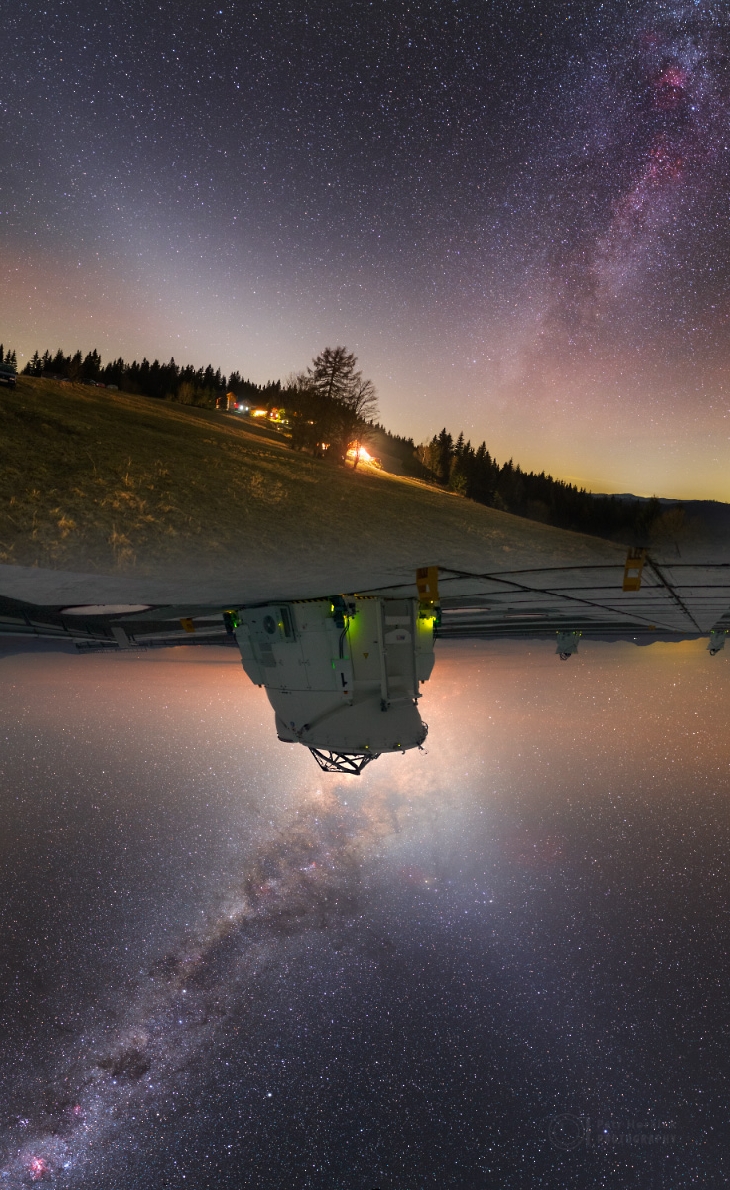
Celestial X - Zodiacal light and Milky Way from both hemispheres
Taken by Petr Horalek on January 26, 2016 @
Oravska Leska, Slovakia / Paranal Observatory, Chile
Click photo for larger image

| |
Camera Used: Unavailable Unavailable
Exposure Time: 15/1
Aperture: Unavailable
ISO: 4000
Date Taken: 2016:01:24 19:37:18
|
|
More images
Details:
This image shows view to the sky in January from both hemispheres. It ingeniously uses the compositions and timing to demonstrate different views in the Milky Way and the zodiacal light close to the Sun in the sky, which is located in both cases under the horizon. While the upper image was taken from Slovakia on 2 January 2016 after the sunset, the bottom image just before the dusk in the early Chilean morning on 26 January 2015. Except the columns of the zodiacal light you can also notice reddish or pink H II regions emission nebulae in the visible plane of our Galaxy. On the northern hemisphere, the most noticeable is NGC 7000 or The North America Nebula (close to the upper right corner), while on the south – in completely opposite position – you can find a rose-shaped Carina Nebula. Both images were captured with same equipment in almost the same season, just with a year difference between first and the second one. Unfortunately, the northern part (from Slovakian village Oravska Lesna) is pretty much disturbed by the light pollution unlike the southern part, captured from ESO’s Paranal Observatory, which is located in incredibly naturally dark spot of the Atacama Desert.
Used Canon 6D IR Baader modified, Samyang 24 mm, f2.0, ISO 8000. Image from Slovakia (upper) is 23×15 seconds panorama, image form Chile (bottom) is 24×15 seconds panorama. Both images taken only from tripod.
More can be found here: http://www.astronom.cz/horalek/?p=2149
Photographer's website:
http://www.astronom.cz/horalek/
|
|
|