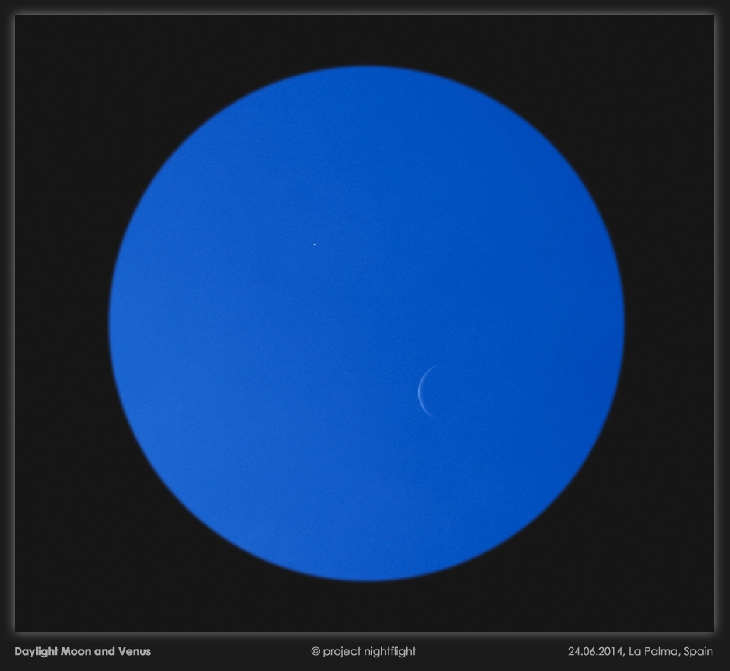
Venus and Moon in Daytime Sky
Taken by project nightflight on June 24, 2014 @
La Palma, Spain
Click photo for larger image

| |
Camera Used: Canon Canon EOS 350D DIGITAL
Exposure Time: Unavailable
Aperture: Unavailable
ISO: Unavailable
Date Taken: 2015:09:07 18:41:11
|
|
| More images
Details:
If seeing Venus with your naked eye in the daylight sky is one of the items on your bucket list, October 8, 2015 is the day to look. On this particular day the Moon will point you to our sister planet, which will help you find it. What is more, Venus will be nearly as bright as it can be, shining at magnitude -4.5 around this time. This means it will stand out well against the bright background of the daylight sky. The northern hemisphere's crisp, blue skies of fall might help as well.
The image gives an idea of how it will look in binoculars. It was shot during a similar conjunction in 2014.
Here's how to see it on October 8 or 9 in the northern hemisphere: Go outside at about ten o' clock in the morning, your local time. The sun will still be fairly low in the southeast, rising, and the pairing of Moon and Venus will be high up in the south. The Moon is a rather slim, waning crescent, with only five days left until new moon. Position yourself in the shade of a building and look for the Moon. Depending on where you are, Venus will be located in different places relative to the Moon, as given below.
Distance and position of Venus relative to Moon, looking south:
Europe: Venus about 5 degrees left of Moon (October 8)
North America: Venus about 3 degrees left of Moon (October 8)
Hawaii: Venus about 1 degree above Moon (October 8)
Asia: Venus about 2.5 degrees right of Moon (October 9)
Russia: Venus about 5 degrees above right of Moon (October 9)
If you can't find Venus right away, try using a binocular to locate it and then look at the same place without the instrument. You will most likely spot it immediately.
Warning: Looking at or near the Sun with binoculars or a telescope will cause immediate and irreversible damage to your eyes. Always stay in an area that is shaded from the sun when observing the daytime sky. Minors should always have adult supervision while observing.
Photographer's website:
http://www.project-nightflight.net
|
|
|