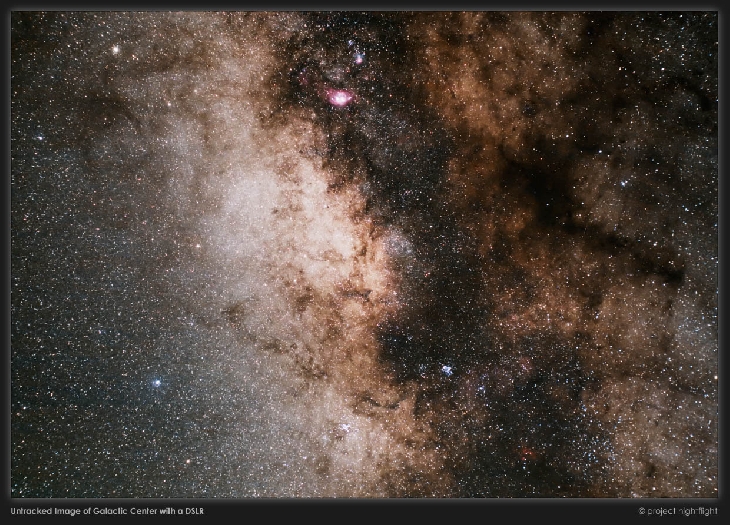
Galactic Center Untracked
Taken by project nightflight on June 9, 2015 @
La Palma, Spain
Click photo for larger image

| |
Camera Used: Unavailable Unavailable
Exposure Time: Unavailable
Aperture: Unavailable
ISO: Unavailable
Date Taken: 2015:08:05 21:29:32
|
|
| More images
Details:
For astrophotography with a DSLR it is common practice to set the camera on top of an equatorial mount or other tracking device. This way, Earth's rotation gets compensated and long exposures of star fields and the Milky Way become possible.
After a series of extended experiments we are now able to present a simple method for DSLR astrophotography where an equatorial mount or a sky tracker is no longer necessary. All that is needed is one of the newer DSLR models that allows high ISO settings, a tripod and a remote release timer. The full article, including a workfow tutorial, is available for free download here:
http://project-nightflight.net/DSLR_astrophotography_untracked.pdf
In short, the basic idea of untracked DSLR astrophotography is quite simple. Shoot a high number of similar exposures at very high ISO ratings and keep the single exposures so short that no tracking is needed. The individual frames are then digitally combined in a stacking program, where the computer virtually does the tracking. The resulting picture shows faint details and is free of the noise that normally comes with the high ISO setting.
Photographer's website:
http://www.project-nightflight.net
|
|
|